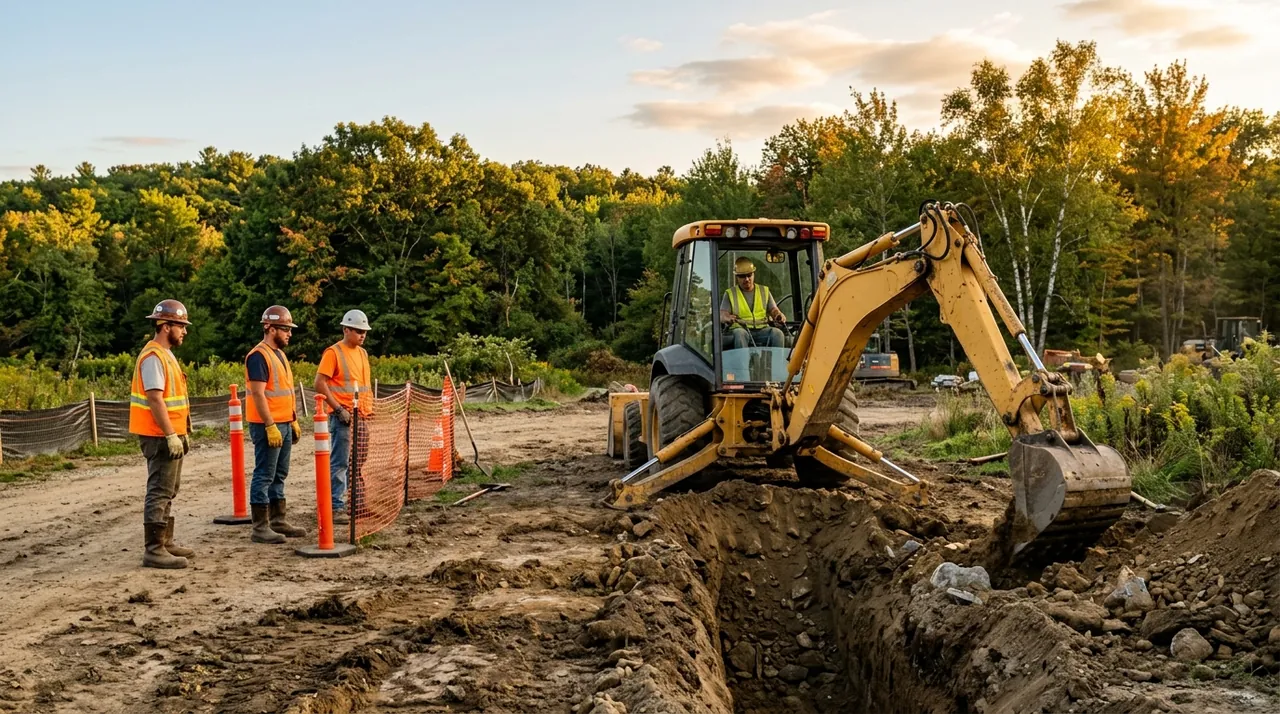
Of all the hazards a backhoe loader operator faces, striking an underground utility ranks among the most immediately life-threatening. A ruptured gas line can ignite in seconds. Contact with an energized electric line can kill the operator and anyone nearby before they react. Massachusetts requires you to notify Dig Safe before any ground disturbance — no exceptions, no minimum depth. This lesson covers what that requirement means in practice, how to read and respect utility marks, and what to do when something goes wrong.
The Dig Safe requirement and why it is not optional
Before you put a backhoe bucket into the ground anywhere in Massachusetts, you are required by state law to notify Dig Safe by calling 811. The call triggers a locate request that goes to every utility with infrastructure in your work area. Each utility sends a locator to mark its lines with paint or flags before your dig window opens. You must wait the full notice period after calling — starting before marks are in place is a violation of the law, not just a bad practice.
If marks are destroyed or faded before the job is complete, you must re-notify Dig Safe and wait again. Keep a record of your locate number and the date you called — that documentation protects you if a dispute arises.
Reading and respecting the utility color code
Locators use a standardized color code every operator must know: red for electric, yellow for gas and petroleum, orange for communications and fiber, blue for potable water, green for sewer and storm drain, and white for the limits of your proposed excavation. Each color signals a different hazard.
The critical point is that marks are approximate. The paint or flag shows where the locator believes the line runs based on records and detection equipment. The actual line can be offset significantly from the mark, and depth is never guaranteed. The regulations therefore establish a tolerance zone around each mark — a buffer within which you stop power digging and switch to hand tools or soft-dig methods. Potholing, exposing the line by vacuum excavation or careful hand digging, lets you confirm its exact location before the bucket goes near it.
Working safely around known utilities
Once marks are confirmed, your digging method changes. Use a spotter outside the cab to watch the bucket's relationship to marks and call out as depth increases. Keep bucket movement slow — fast, aggressive digging is how lines get hit. If working parallel to a line, keep the bucket aligned so a slip does not cross the mark. If you must cross perpendicular to a line, expose it by hand first and pass under it carefully.
Do not assume an old or faded mark means the line was removed. Do not assume a residential area means shallow lines. Slow, deliberate work with a spotter is not a sign of inexperience — it is how experienced operators stay out of incident reports.
Responding to a utility strike
No matter how careful you are, strikes happen. What you do in the first thirty seconds determines how bad the outcome gets.
If you rupture a gas line, stop immediately without moving the machine. Eliminate ignition sources. Get everyone moving upwind and away. Do not use cell phones or radios near the area. Call 911 and the gas utility from a safe distance. Do not re-enter until the utility secures the line and responders clear the scene.
If the machine contacts an energized electric line and becomes energized, stay in the cab. Stepping off completes a ground path through your body. Warn anyone nearby to stay back — touching an energized machine while standing on the ground is fatal. Call for help. If fire forces you to exit, jump clear without touching the machine and the ground at the same time, land with feet together, and shuffle away without lifting your feet.
For water and sewer strikes, the immediate threat is trench instability — saturated soil can collapse a wall that looked solid moments earlier. Get people out of any open trench and away from the edge. Fiber and communications strikes carry no immediate physical risk but significant liability; document and report them promptly.
Key Takeaways
- •Call 811 before every excavation in Massachusetts and wait the full notice period — this is a legal requirement, not a courtesy.
- •Utility marks are approximate: the tolerance zone around each mark requires hand digging or soft-dig methods, not power bucket work.
- •Know the color code: red electric, yellow gas/oil, orange communications, blue water, green sewer, white proposed dig limits.
- •Gas line strike: stop, evacuate upwind, eliminate ignition sources, call 911 and the gas utility from a safe distance.
- •Electric line contact: stay in the cab, warn others away, call for help — exiting the energized machine to the ground is the fatal mistake.