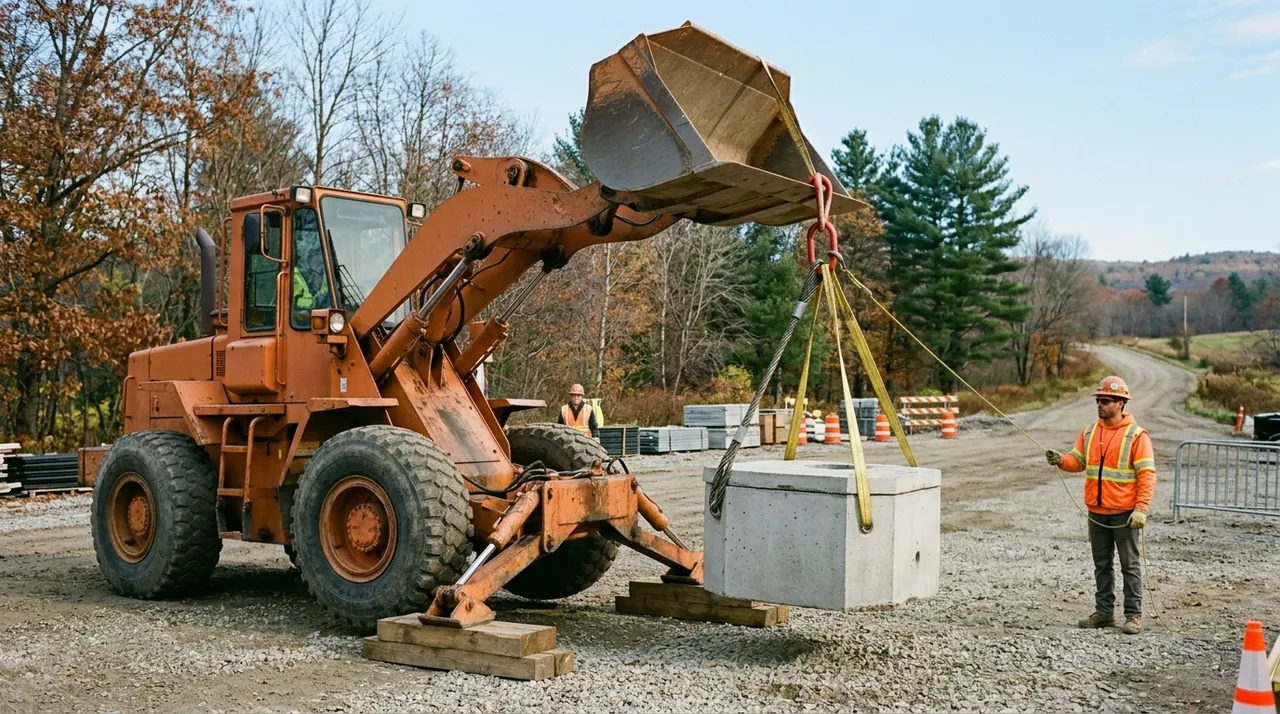
A wheel loader looks stable — low to the ground, four wide tires, a heavy counterweight at the rear. That impression is deceptive. The moment you raise the bucket, accelerate into a turn, or park a tire too close to a soft edge, the machine's center of gravity starts working against you. Tip-over and rollover accidents are among the most preventable fatalities in the industry, and they almost always happen because an operator ignored conditions the manufacturer's manual addresses directly. This lesson covers the physics and the practices that keep the machine upright.
Center of Gravity and What Moves It
Every wheel loader has a center of gravity — the point where the machine's total weight is effectively balanced. When that point stays low and inside the wheelbase, the loader is stable. When it shifts too far forward, backward, or to either side, the machine tips toward whichever corner can no longer support the load.
Raising the bucket moves the center of gravity upward and forward simultaneously. A load that is manageable at ground level becomes a real stability threat at full height. The rule is simple: travel with the bucket low — just high enough to clear the ground — never raised in the air. Frame articulation creates a separate problem. When the loader turns through its articulation point, lateral stability drops. Manufacturers publish a full-turn rated operating capacity that is lower than the straight-ahead figure for exactly this reason, and that lower number governs whenever you are turning. The load chart is your reference for both figures — consult it before each job and never exceed the rated capacity in any configuration.
Grades, Ramps, and Dynamic Forces
Static stability describes a machine sitting still on level ground. Dynamic stability is what matters on the job, because braking, accelerating, and steering all add forces that a static picture ignores. A sudden stop throws the load forward; an abrupt turn throws it sideways. Either input can tip a loader that would have been perfectly stable at lower speed with smoother inputs.
On grades and ramps, gravity becomes the dominant factor. Reduce speed before you reach the slope. Avoid crossing a grade at an angle when you can travel straight up or down — side-hilling is a leading cause of lateral rollovers because the center of gravity is already displaced toward the downhill side. Do not coast on a descent in neutral; use the machine's drivetrain to control speed.
Loaded vs. Empty on a Slope
The rules for slope travel depend on whether the bucket is loaded or empty. When carrying a load on any grade, keep the heavy end uphill. Going up a ramp with a loaded bucket means the bucket faces uphill. Descending with a load, the bucket still faces uphill — you back down the ramp. This keeps the machine's weight over the uphill axle and prevents the load from pulling the nose down and over.
When the bucket is empty, the counterweight end is heavier, so traveling down a slope with the bucket forward is the safer orientation. The principle is always the same: keep the heavier end toward the top of the slope.
Ground Hazards and Surviving a Tip-Over
Solid, well-compacted ground is predictable. The conditions that cause rollovers are the ones that are not — soft shoulders, trench edges, and stockpile edges where the surface looks firm but will not hold the machine's weight. Inspect your travel path before using it. Potholes, curbs, and buried objects can pitch the machine without warning. Tire condition and inflation matter too: an underinflated or damaged tire reduces the machine's effective footprint and stability.
If a tip-over begins, stay in the cab, stay belted, and brace. Jumping is statistically more dangerous than riding the machine down. ROPS exists to preserve a survival space, but only if you are inside it and wearing the seat belt when it matters.
Key Takeaways
- •Keep the bucket low during travel — raising the load shifts the center of gravity forward and upward, reducing stability.
- •On any grade, keep the heavier end uphill: loaded bucket faces uphill going up and going down; reverse for an empty bucket.
- •Frame articulation reduces lateral stability — use the manufacturer's full-turn rated operating capacity, which is lower than straight-ahead capacity.
- •Avoid soft shoulders, trench edges, and stockpile edges where surface collapse can occur without warning; inspect your travel path first.
- •If a tip-over begins, stay belted inside the cab and brace — do not jump. ROPS only protects you if you remain inside it.
- •Always consult the manufacturer's load chart before each job — straight-ahead and full-turn capacities are different figures, and neither one may be exceeded.