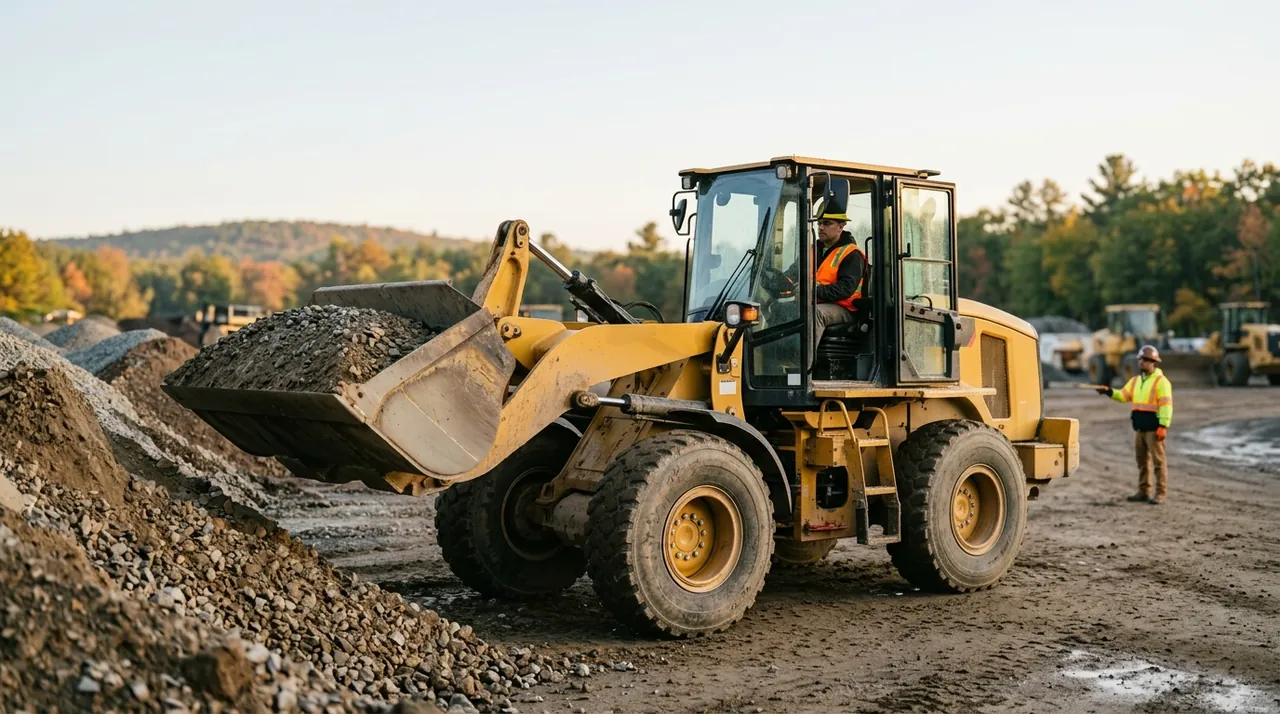
A front-end loader does one thing over and over: pick up material and move it somewhere else. That sounds simple until you watch a machine tip forward into a spoil pile or drop a load through a haul truck cab. Bucket technique and load handling are where most loader accidents begin, and where most loader productivity is won or lost. This session covers how to approach a pile, fill the bucket correctly, and carry and place material without putting the machine, the load, or a coworker at risk.
Approaching the pile and filling the bucket
Every loading cycle starts with how you come into the pile. Approach square — centered on the material, with the bucket flat and the cutting edge riding close to the ground. Coming in at an angle forces the machine to push with one corner of the bucket, which side-loads the linkage and front axle in a way they are not designed to handle.
Once you are in contact with the material, use the crowd-and-curl sequence: push forward into the pile to let the bucket fill, then curl the bucket back toward the machine while raising the arms slightly to capture the load. Avoid driving hard down into the material with excessive down-pressure — you are not increasing capacity by prying, you are stressing the front axle. Before you reverse, roll the bucket fully back so the load sits against the back of the bucket rather than balanced near the lip. A partially curled bucket loses material over bumps and reduces the stability advantage you get from carrying the load low.
Carrying the load safely
The most important rule for traveling with a loaded bucket is to keep it low. The bucket should be just high enough to clear the ground and any obstacles in your path — manufacturer guidance typically places this at about a foot off the ground. This is not about ground clearance; it is about where the machine's center of gravity sits.
When you raise a heavy bucket, you move weight upward and forward, which shifts the center of gravity up and away from the rear axle. The higher the load, the less lateral disturbance it takes to initiate a tip. A raised, loaded bucket combined with a sharp turn or a sudden stop is one of the most reliable ways to roll a wheel loader. Keep the load low, match your speed to the ground conditions and visibility, and never make sudden starts, stops, or turns with a raised load.
Loading trucks and placing material
When loading a haul truck, spot the truck first, confirm the driver is out of the cab or the cab is protected, and approach from the side or rear. Never pass the bucket over the truck cab. Beyond the obvious crush hazard if material falls, you cannot reliably know that someone has not returned to that cab between cycles.
Load evenly across the truck bed and monitor the cumulative weight against the truck's rated capacity. Overloading is not just a road problem — an overloaded truck on soft ground can fail a crossing a properly loaded truck would handle. For dumping at a stockpile, ease the bucket out rather than snapping it open. Throwing material creates scatter and can destabilize the edge you are building toward. Back out of the pile with the load low before raising to dump, keeping your sight lines clear through the transition.
Key Takeaways
- •Approach the pile square with the bucket flat and cutting edge near ground level — angled approaches side-load the linkage.
- •Use the crowd-and-curl sequence, then roll the bucket fully back to retain the load before reversing out.
- •Carry the bucket low while traveling — a raised, loaded bucket shifts the center of gravity upward and increases tip-over risk.
- •Never pass the bucket over a haul truck cab, and load the truck evenly without exceeding its rated capacity.
- •Ease material out when dumping rather than throwing it, and back out of the pile with the load low before raising to dump.