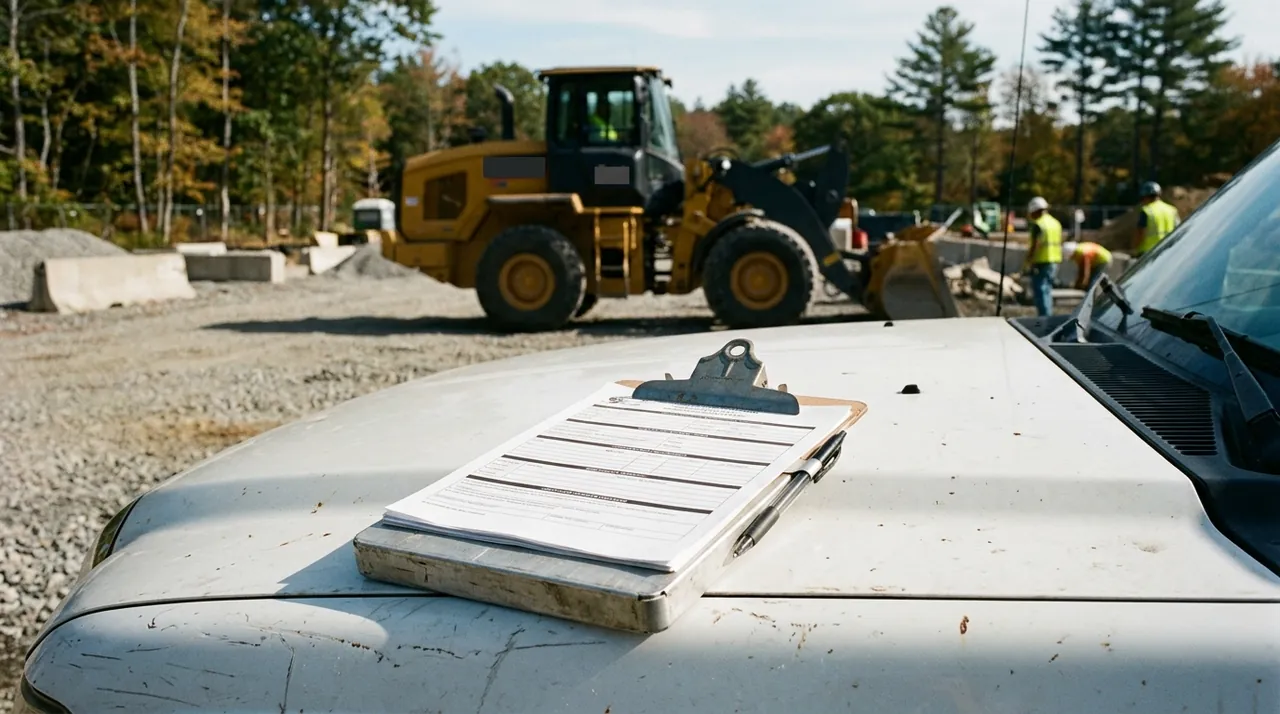
Before you sit down for the Massachusetts 2C exam, you need two things working together: a solid grasp of the licensing rules that govern hoisting work in the Commonwealth, and a clear mental picture of the front-end loader as a machine. This session pulls those threads together, reviewing the legal framework and administrative facts most likely to appear as exam questions, then tying that foundation to the equipment — the mechanical systems and safety features that define how a wheel loader operates and what keeps it stable on the job.
The legal framework: statute, regulation, and issuing agency
Massachusetts hoisting license law lives in two places. The enabling statute is M.G.L. c. 146. The operative regulation — the one that sets license classes, fees, and administrative procedures — is 230 CMR 6.00. That citation is worth memorizing exactly, because one of the most reliable exam traps is substituting 520 CMR 6.00, which is the old, superseded citation for the same hoisting rules (they were recodified as 230 CMR 6.00). If you see 520 CMR 6.00 on an exam answer choice, it is outdated and wrong.
The agency that issues and enforces the license is the Division of Occupational Licensure (DOL), Office of Public Safety and Inspections (OPSI). Another frequent wrong answer is the Department of Public Safety, which handles different licensing programs. Knowing the correct agency is a straightforward point-giver that many candidates miss.
Administrative facts and the scope of the 2C restriction
The exam will test the basic rules of the license itself. You must be at least 18 years old. Each restriction costs $75, nonrefundable. The license runs two years and may be renewed up to 60 days before expiration. Continuing education requirements are set out under 230 CMR 6.04.
The 2C restriction covers rubber-tired front-end loaders and also authorizes the holder to operate 2D compact machinery. What it does not cover is aerial lifts — that is a separate restriction, and the exam will test that boundary. The regulations also carve out exemptions for agricultural operators on their own land and workers in supervised utility, apprenticeship, or vocational programs. The operative word is supervised: unsupervised operation still requires the license.
How the wheel loader is built
A front-end loader is an articulated machine — the front and rear frames join at a pivot point rather than steering through the front axle. When you turn, the rear frame tracks straight while the front frame swings out. This gives the machine a tight turning radius but also shifts the stability picture when turning under load, which is why capacity ratings account for the most demanding conditions.
The hydraulic system powers both the lift arms and bucket tilt. Different bucket types are matched to material density and job type. Understanding that hydraulics are the working muscle of the loader helps you recognize why a leak or pressure loss is an immediate out-of-service condition, not a "watch it" problem.
Stability, counterweight, and protective structures
Every wheel loader carries a counterweight at the rear to balance the load up front. The machine's center of gravity must stay within the wheel footprint, or the loader tips forward. Raising the arms higher or extending the load farther forward shifts that center of gravity — which is why rated capacity is based on the worst-case position, not the easiest one.
ROPS and FOPS are the two cab-protection structures. ROPS maintains a survivable space during a tip-over; FOPS shields the operator from falling material. Both structures depend on a buckled seat belt to work as designed — an unbelted operator can be thrown from the cab even with ROPS intact. The exam treats the seat belt requirement and protection against tampering with ROPS as serious, no-exception rules.
Key Takeaways
- •The controlling regulation is 230 CMR 6.00, not 520 CMR — that substitution is the most common exam trap.
- •The issuing agency is DOL / OPSI, not the Department of Public Safety.
- •Key administrative facts: age 18, $75 nonrefundable per restriction, 2-year term, renewable up to 60 days before expiration, CE under 230 CMR 6.04.
- •A 2C covers rubber-tired front-end loaders and authorizes 2D compact machinery, but does NOT cover aerial lifts.
- •Articulated-frame steering, counterweight position, and center of gravity all govern stability — ROPS and a buckled seat belt are non-negotiable.