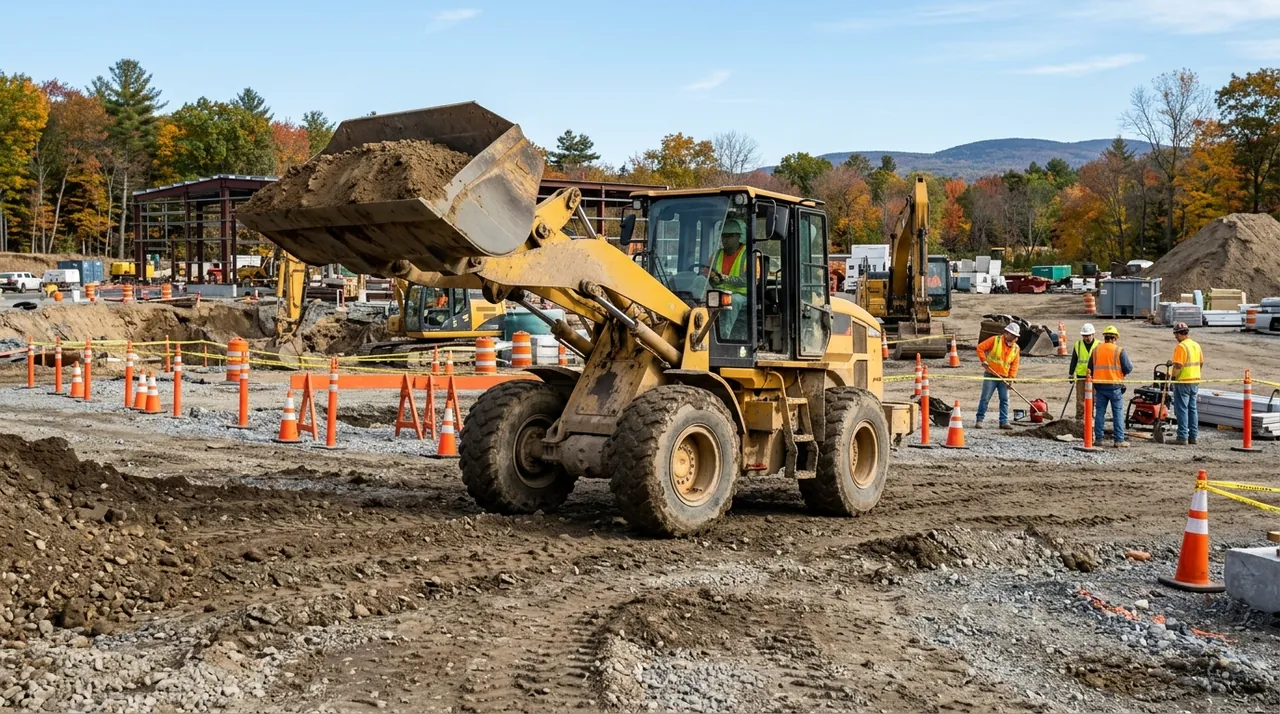
This session brings everything together for exam day. You have covered the law, the machine, and the daily inspection. Now the job is to apply all of it under pressure — reading a scenario question carefully, identifying the one rule that controls the situation, and committing to the right answer. The exam will test whether you know the difference between a judgment call and a hard rule with no exceptions. This review focuses on the rules that belong in the second category.
Stability and load handling
A front-end loader's rated capacity is based on a specific condition: the load is carried low, close to the ground, traveling on a level surface. Every time you raise a load — even briefly to clear an obstacle — you shift the center of gravity upward and forward. The machine becomes easier to tip, and a rut or sudden turn can do what the load alone would not. The rule is straightforward: travel with the bucket down.
On grades, the rule is equally clear: keep the heavy end uphill. When the bucket is loaded, that means the bucket faces uphill whether you are going up or coming down. This keeps the weight over the front axle rather than pulling the machine forward over its nose. Travel straight up and down grades rather than angling across them — a diagonal path across a slope shifts the tipping geometry in a far less forgiving direction.
ROPS, FOPS, seat belts, and what to do if the machine tips
The ROPS — rollover protective structure — is a certified safety cage. Its rating is based on tests performed on the structure exactly as the manufacturer built it. Any damage that changes the geometry, whether from a tip-over, a collision, or an unauthorized weld repair, voids the certification. A visibly cracked or bent ROPS means the machine comes out of service immediately. There is no field repair that restores it.
A wheel loader may also be equipped with a FOPS — falling-object protective structure — rated to protect the operator from material falling from above. Like the ROPS, any modification or damage to the FOPS voids its certification and requires removal from service. Both structures must be intact and unmodified to provide the protection they were designed and tested to deliver.
The seat belt exists specifically because of the ROPS. The structure keeps the cab space intact in a tip-over, but only if the operator stays inside it. An operator who tries to jump will be crushed by the same cage that would have protected them. The correct action is to stay belted, grip the wheel, and brace. OSHA 1926.602 requires seat belts on all equipment with ROPS — not as an option, but as a mandatory operating condition.
Blind spots, backup hazards, and the articulation joint
A wheel loader's cab sits well forward on the machine, and the engine compartment behind it creates significant blind spots to the rear. OSHA 1926.602 requires a backup alarm or a signaler when the operator's rear view is obstructed. If a spotter is used, the operator takes directional signals from that one designated person and stops immediately if that person or anyone else gives an emergency stop signal.
The center articulation joint is a crush hazard in its own right. When the machine steers, the front and rear frames pivot at this joint. Anyone standing between the frames during operation is at immediate risk. The exclusion zone here is not negotiable. When the machine goes in for service, the frame lock bar physically pins the two halves together so no one gets caught in a moving joint while working on the machine.
Pre-shift inspection and the 360 walk-around
Before you move the machine, you complete a full 360-degree walk-around. This is not a formality — it is your best opportunity to catch a removal-from-service condition before it becomes an incident. You are looking at tires, fluid leaks, structural damage to the ROPS and FOPS, attachment pins, lights, and the area immediately around the machine for people or obstacles. Check the backup alarm and horn function during the walk-around, not after you are already moving.
If you discover a defect that is a removal-from-service condition — non-functional brakes, a cracked ROPS, a dead backup alarm — the machine does not operate that shift. You tag it, report it, and let supervision know. The machine comes back into service only after an authorized repair and a fresh inspection sign-off. Catching a defect in the pre-shift inspection is the system working as intended.
Applying the rules to scenario questions
Exam scenarios are designed to offer a plausible but wrong answer alongside the correct one. The wrong answer describes what a crew might actually do on a real job — cutting a corner to stay on schedule. Your job is to identify what the rule requires, not what is convenient.
The clearest pattern on loader questions is the removal-from-service rule. Under OSHA 1926.602, defective equipment must be taken out of service — it cannot be operated while defective, regardless of urgency. If the scenario describes non-functional brakes, a cracked ROPS, a dead backup alarm, or a broken seat belt, the answer is always to remove the machine from service. The question will usually add a time constraint to tempt you toward the wrong choice. Recognize the pattern: when a removal-from-service condition appears, it is the deciding fact.
Key Takeaways
- •Travel with the bucket low to keep the center of gravity down; a raised load reduces stability and increases tip-over risk.
- •On grades, keep the loaded bucket facing uphill and travel straight up or down — never diagonally across a slope.
- •Any ROPS or FOPS damage or modification requires immediate removal from service; stay belted and brace in a tip-over rather than jumping.
- •OSHA 1926.602 requires a backup alarm or signaler when the rear view is obstructed; Emergency Stop from anyone must be obeyed instantly.
- •The pre-shift 360 walk-around is your last line of defense — any removal-from-service condition found there (bad brakes, cracked ROPS, dead alarm) ends the task before it starts.
- •Removal-from-service conditions discovered at any point — pre-shift or mid-task — end the operation regardless of production pressure.