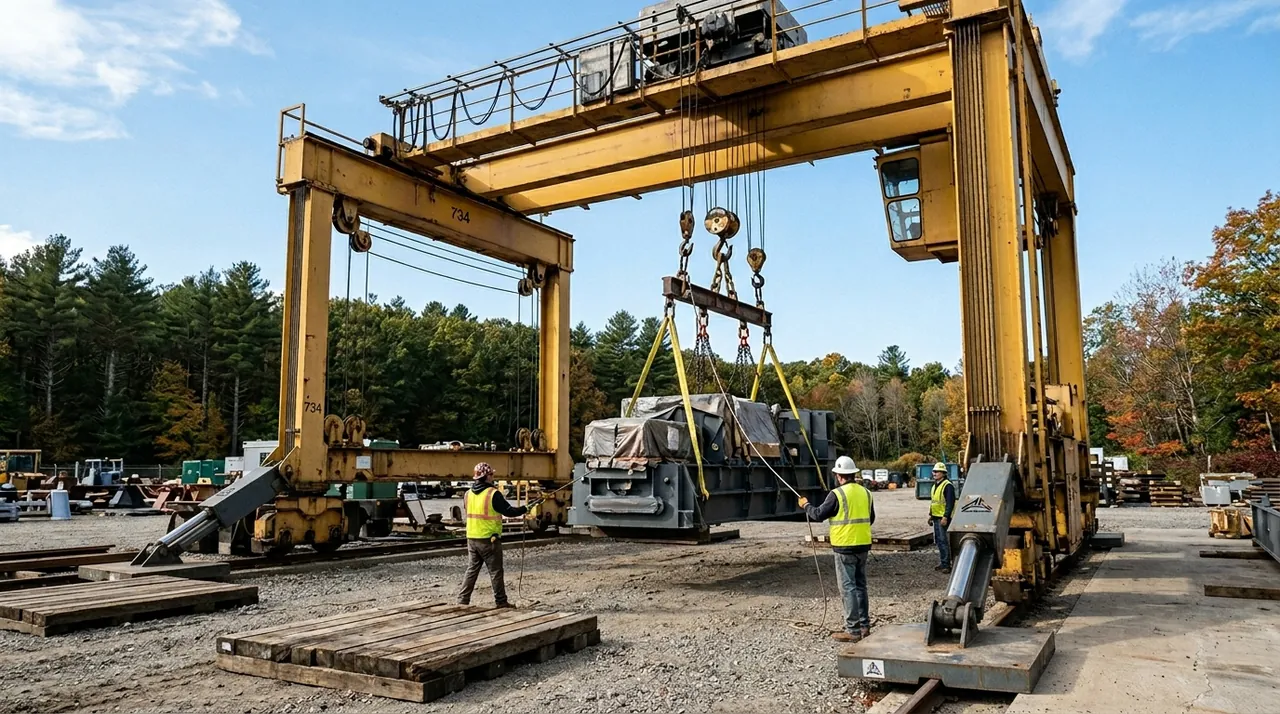
The hoist or crane supplies the lifting force, but the rigging connects that force to the load — and a rigging failure does not give you a second chance. This session covers the slings, hooks, shackles, and below-the-hook devices that 3A operators work with every day: how to read rated capacities, how sling angle quietly multiplies tension in every leg, how to inspect each component before use, and what the regulations require for specialized lifting devices under ASME B30.20.
Sling Types and Working Load Limits
Every sling falls into one of four families: alloy chain, wire rope, synthetic web, or round slings. Alloy chain is the most durable and heat-resistant. Wire rope handles shock loading better than synthetics. Synthetic web and round slings are lighter and gentler on finished surfaces, but they can be cut by sharp edges and degraded by chemicals or UV exposure.
Regardless of type, every sling must carry a legible tag stating its working load limit, or WLL. If the tag is missing or unreadable, the sling comes out of service immediately. The WLL is the manufacturer's rated capacity under specified conditions, and it is the ceiling you never exceed.
Sling Angle: The Force Multiplier You Cannot Ignore
When a two-leg sling hangs nearly vertical, each leg carries roughly half the load weight. As the legs spread outward and the angle between each leg and the load decreases, the tension in each leg rises sharply — even though the total weight has not changed. At a very shallow angle, leg tension can far exceed the weight being lifted, causing sling failure while the load is still within the crane's rated capacity.
Keep sling angles as steep as practical. Use a spreader bar or lifting beam when a direct sling rig would force the legs too far apart. Always base your rigging capacity on the actual angle on the day of the lift.
Hooks, Shackles, and Below-the-Hook Devices
Two conditions end a hook's service life: a throat opening that has widened beyond allowable limits (a sign of overload) and a latch that does not spring back and seat fully. Never repair a hook in the field — replace it. Shackles must be pinned fully and oriented so the load pulls in line with the pin, not across the bow. Side-loading a shackle dramatically reduces its rated capacity and is one of the most common rigging errors.
Spreader bars, lifting beams, C-hooks, and plate clamps are below-the-hook lifting devices regulated by ASME B30.20. That standard requires each device to be load-rated and marked with that rating. These are engineered components, not improvised hardware. Verify the device rating against the rigging plan before every lift.
Inspection and Load Control
Before any sling goes on a load, inspect it. Chain slings: look for elongation, nicks or gouges in the links, and twisted or bent links that signal a shock load. Wire rope slings: count broken wires, especially clustered breaks in a short section, which are a removal condition even at a low total count. Synthetic slings: look for cuts, abrasion, chemical stiffness or discoloration, and UV brittleness. Heat damage on any sling type is an immediate discard.
Once rigging is selected, locate the load's center of gravity. An asymmetric load rigged to a centered pick point will tilt when lifted. Adjust the pick point or rigging geometry so the center of gravity sits directly below the hook before you take tension. Attach tag lines to any load that could rotate or swing — they give ground crews control without putting anyone under the load.
Key Takeaways
- •Every sling must have a legible WLL tag — no tag means out of service, no exceptions.
- •Sling angle is a force multiplier: as legs spread further from vertical, tension in each leg increases sharply even though the load weight stays the same.
- •Remove hooks with widened throats or faulty latches; never side-load a shackle.
- •Below-the-hook devices (spreader bars, lifting beams, C-hooks, plate clamps) are governed by ASME B30.20 and must be load-rated and marked.
- •Inspect chain slings for stretch and damaged links, wire rope for broken wires, and synthetic slings for cuts, abrasion, and chemical or UV damage before every use.