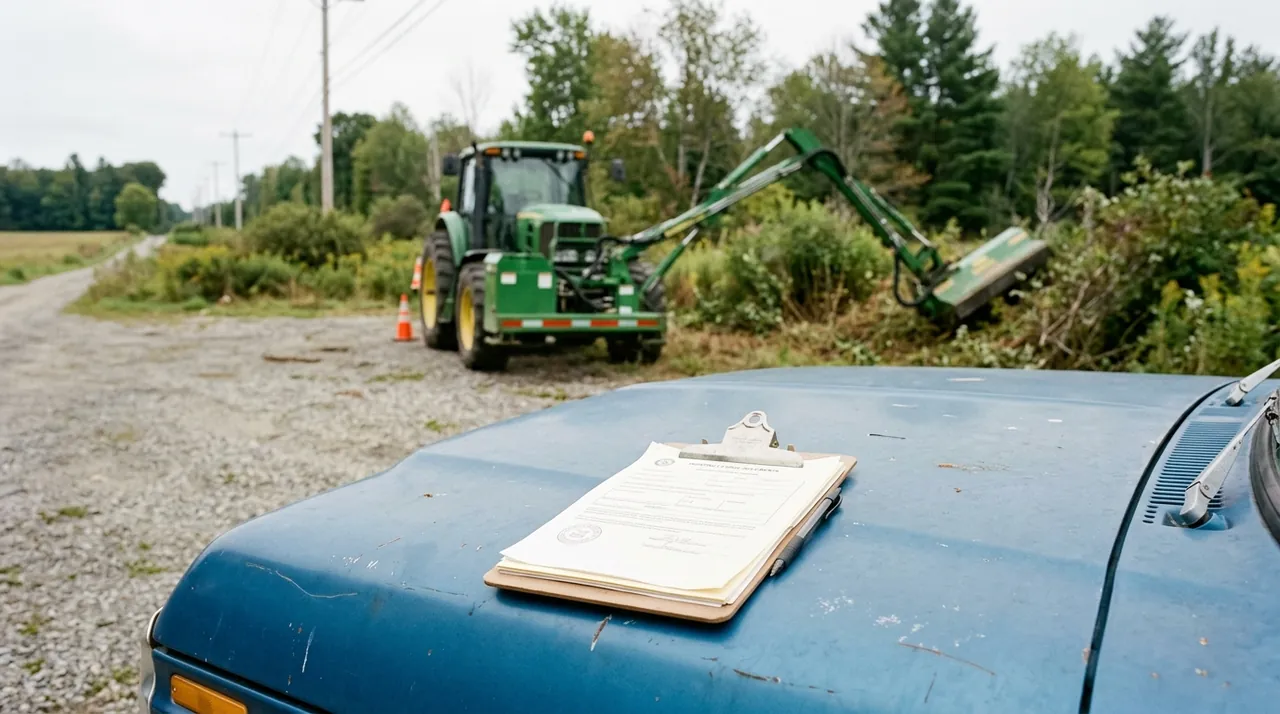
Massachusetts created a separate, narrower category for the crews who keep public roads clear and safe: the HEML, or Hoisting Engineer — Municipal Limited. If you are studying for the 4G restriction, this license is your credential, and understanding exactly what it authorizes — and what it does not — is the foundation of operating legally. This session covers the structure of the HEML license, the scope of each of its three restrictions, and the continuing-education and renewal rules that keep you in the field without interruption.
What the HEML license is and who it serves
The HEML is a limited-purpose hoisting license issued by the Commonwealth for public-works and municipal operations. It is not a stripped-down version of a full license — it is a distinct credential designed for a specific mission: the roadside and right-of-way work that municipal DPW crews, highway departments, and right-of-way contractors perform every day. Because that work involves a defined set of machine types, the HEML bundles exactly three restrictions into a single document: 1C (hydraulic telescoping booms), 2B (loader/backhoe equipment), and 4G (side-boom mowers).
Each restriction is its own authorization for a distinct category of equipment. Holding the HEML means you are licensed for all three, but only within the public-works context those restrictions reflect. If your assignment puts you behind the controls of a side-boom mower clearing vegetation along a state highway, the 4G restriction covers that work. If your employer asks you to operate hoisting equipment not covered by any of those three restrictions, your HEML does not authorize it.
The 4G restriction: what it authorizes and what it does not
The 4G restriction specifically covers side-boom mowers — the articulating boom-mounted cutting heads used for roadside and right-of-way vegetation control. This is a precise and deliberate scope. A side-boom mower mounted on a tractor or carrier, extended over a slope or drainage swale to cut vegetation along a public road, is 4G work. A forklift moving pallets at a job-site warehouse is not. A crane lifting structural steel is not. Generic hoisting is not.
This matters because the exam will present scenarios designed to test whether you understand those boundaries. When in doubt, apply a simple test: if the machine is a side-boom mower being used for roadside or right-of-way vegetation control, your 4G authorization applies. If the machine is something else, or the task is general hoisting or material handling, a different license class is required. Knowing the edges of your authorization protects both you and your employer from an operating-without-a-license violation.
Working in the right-of-way: coordination and responsibility
Because 4G operations almost always take place on or adjacent to public roads, they intersect with work-zone and traffic-control requirements. Roadside mowing means the machine is operating near moving traffic, often with the boom extended across a travel lane or shoulder. That environment adds a layer of responsibility beyond simply running the equipment correctly.
Before work begins, municipal crews and right-of-way contractors are expected to coordinate applicable traffic-control measures for the jurisdiction and road classification involved — flaggers, signage, and equipment placement in place before the boom starts moving. As the licensed operator, you are responsible for your machine's footprint in that work zone. Understanding that your license operates within a broader work-zone framework, not independently of it, is the professional posture the regulations and your employer expect.
Continuing education, renewal, and the no-grace-period rule
The HEML license is not a one-time credential. Under 230 CMR 6.04, continuing education is required before renewal — you cannot simply pay a renewal fee and keep operating. The regulations allow renewal up to 60 days before expiration, giving you a clear planning window. Do not wait until the final days before expiration to complete your CE or submit paperwork.
The rule on lapsed licenses is unambiguous: operating on an expired license is operating without a license. There is no grace period. If your HEML expired yesterday and your renewal is pending, you cannot legally operate a side-boom mower today — regardless of how routine the task is or how soon renewal will be processed. Carry your current, valid license while operating and produce it on request. Keep proof of completed continuing education and renewal documentation available for inspection, because those records may be requested separately from the license card.
Key Takeaways
- •The HEML (Hoisting Engineer — Municipal Limited) bundles three restrictions — 1C, 2B, and 4G — into one license for public-works and municipal crews.
- •The 4G restriction covers side-boom mowers used for roadside and right-of-way vegetation control only — it does not authorize forklifts, cranes, or general hoisting.
- •230 CMR 6.04 requires continuing education before each renewal; the renewal window opens up to 60 days before the expiration date.
- •An expired license provides no grace period — operating on a lapsed HEML is operating without a license, regardless of when the renewal will be processed.
- •Carry your license while operating, produce it on request, and keep CE and renewal records available for inspection.