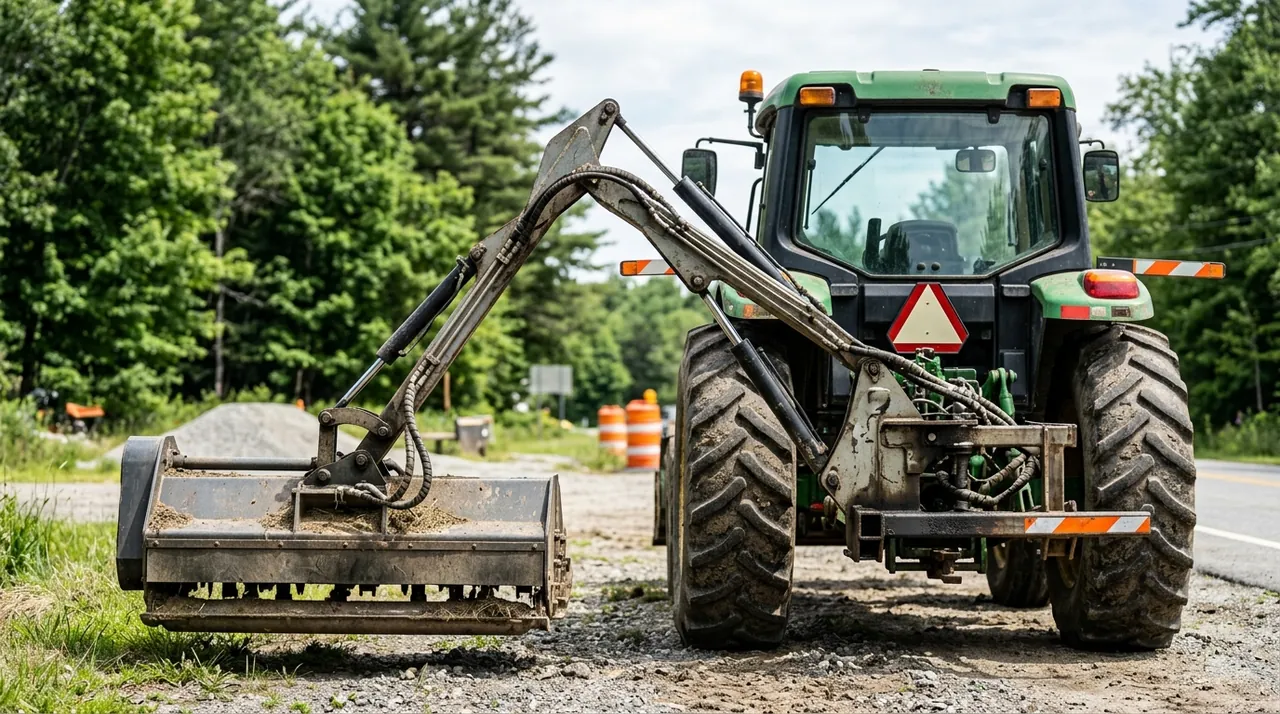
A side-boom mower looks like a tractor at first glance, and that is not an accident — it is a tractor at its core. But the machine you are licensed to operate under the Massachusetts 4G specialty class is considerably more complex than a farm tractor. It is a hydraulically powered, articulating work platform capable of reaching over guardrails and down embankments, and understanding every major assembly is the first requirement for operating it safely and passing the exam.
The Carrier: Foundation of Power and Mobility
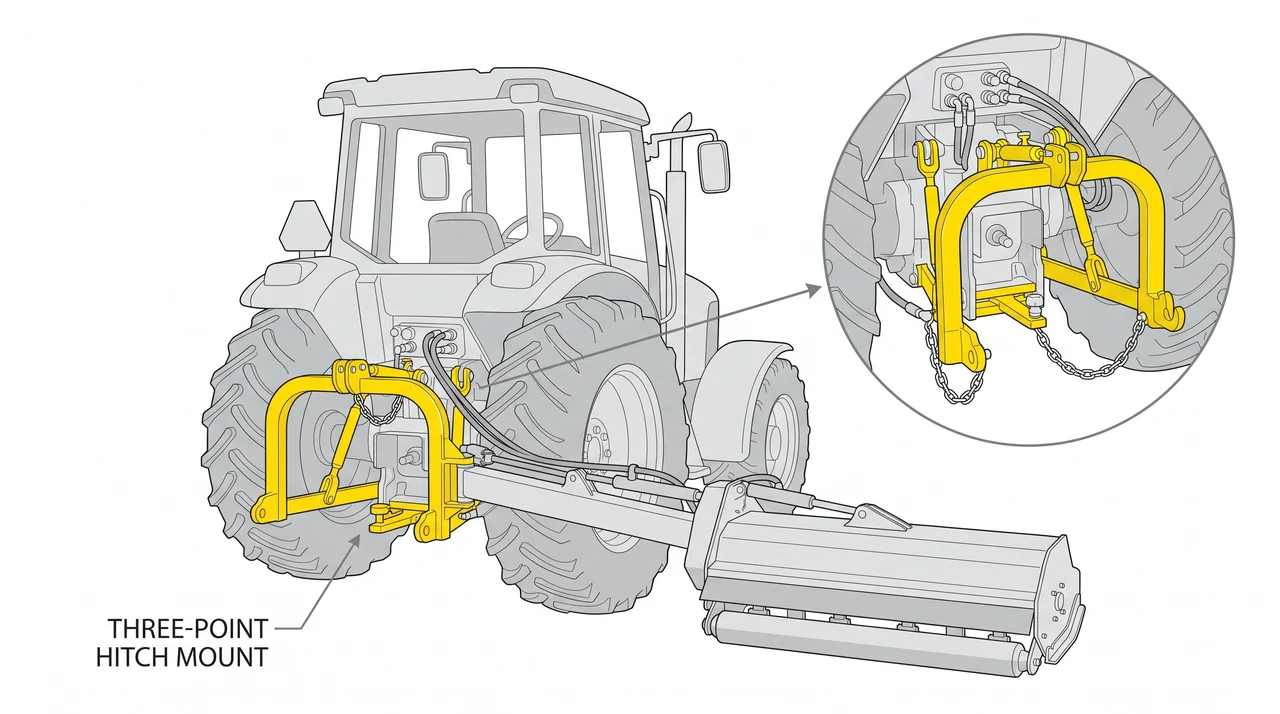
Everything starts with the carrier — the base tractor that supplies mobility, structural support, and the engine power that drives every downstream system. The boom assembly connects to the carrier through either a three-point hitch or a dedicated subframe mount. That connection transfers all boom loads — weight, lateral force, and dynamic shock — directly into the tractor frame. A loose or worn mount undermines the machine's stability, so inspecting it before every operation is not optional.
The Articulating Boom Arm: Reach, Joints, and What They Make Possible
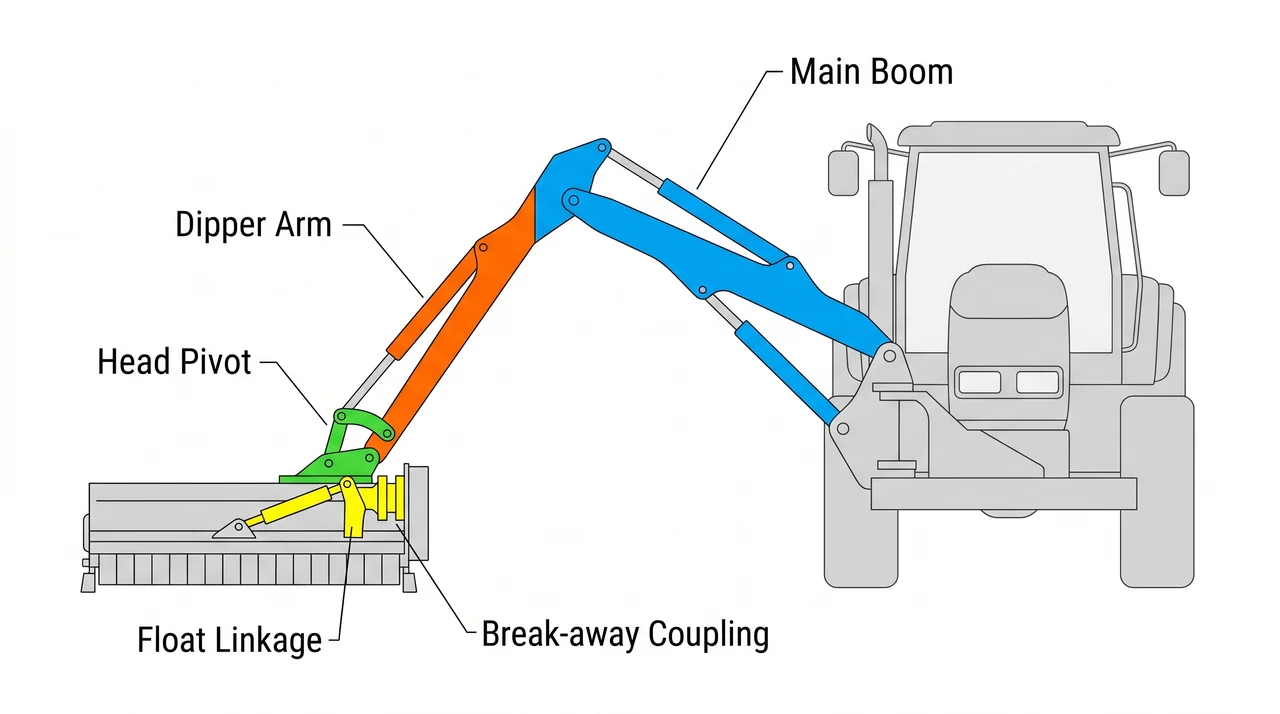
The boom arm defines the machine. It consists of a main boom attached at the carrier, a second-stage dipper arm, and a head pivot where the cutting head mounts. Together these segments let the operator extend the cutting head well beyond the machine's footprint — over guardrails, across ditches, and down steep embankments that cannot safely be driven on.
Two features protect the operator and the machine at the working end. The float function lets the cutting head follow ground contour passively rather than being forced against the terrain by hydraulic pressure, reducing stress on the boom. The break-away feature deflects the head or boom when it strikes a fixed obstacle, absorbing the impact instead of transmitting it through the entire machine structure.
Hydraulics and PTO: The Power Path to the Cutting Head
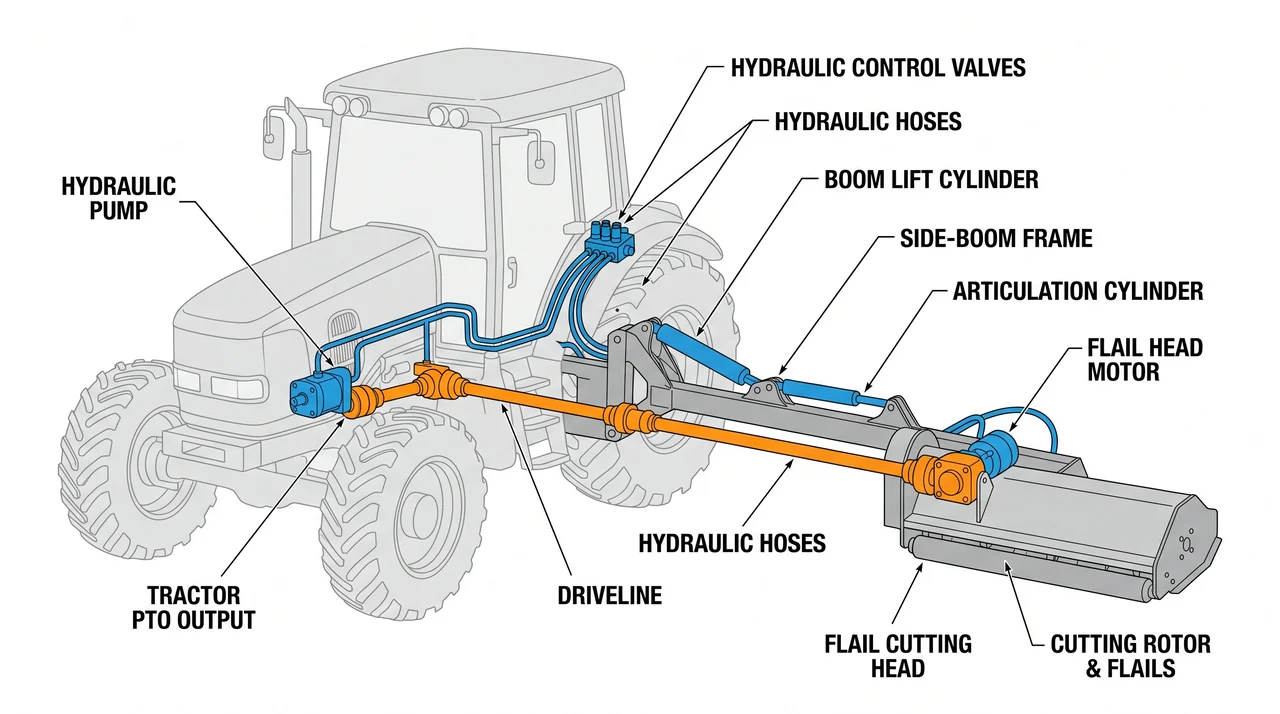
Two systems carry engine power from the carrier to the working end. The PTO transfers mechanical rotation from the tractor engine through a driveline to the hydraulic pump, and in some configurations directly to the cutting head. The hydraulic system converts that input to pressurized fluid, routed through hoses and control valves to the cylinders that move the boom and the motor that spins the head.
Hydraulic pressure in a working system is high enough that a pinhole leak can inject fluid through skin. This is the injection injury hazard — never check for leaks by hand. Use cardboard or wood to detect weeping, or shut down and relieve pressure first. PTO shafts and rotating drivelines carry their own danger and must be fully guarded at all times; entanglement with a spinning shaft is immediately catastrophic.
Stability, ROPS, FOPS, and the Seatbelt
Extending a heavy boom arm far to one side shifts the machine's center of gravity away from its footprint. The farther the reach and the heavier the cutting head, the greater the tipping moment acting on the carrier. Operating on a side slope while the boom is extended compounds the risk significantly. Counterbalance design limits the moment, but every boom movement changes the stability equation — operators must read reach, slope, and load as a continuous picture, not a one-time setup check.
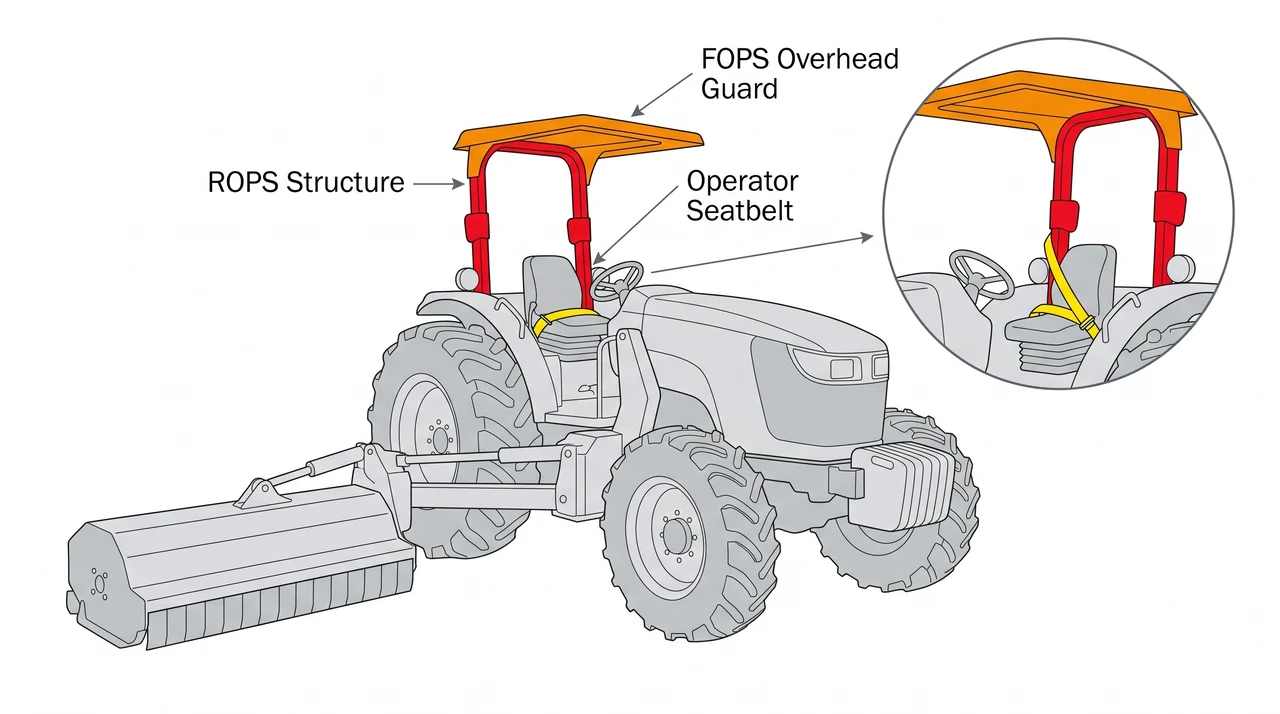
ROPS creates a survival zone around the operator if the machine overturns. FOPS guards the operator station from thrown debris, which side-boom mowers produce constantly — rocks and branches leave the cutting head at high speed. Both structures only work for a restrained operator. If you are not wearing the seatbelt during a rollover, you leave the protection zone and enter the crush zone. The seatbelt is the mechanism that makes ROPS protection possible.
Key Takeaways
- •The carrier tractor provides all mobility and engine power; the three-point hitch or subframe mount transfers all boom loads into the frame, so mount condition matters every shift.
- •The articulating boom arm (main boom, dipper arm, head pivot) achieves reach over guardrails and embankments; float and break-away features protect the terrain and the boom structure.
- •Never check hydraulic leaks by hand — high-pressure fluid causes injection injuries; always relieve pressure before working on the circuit.
- •PTO shafts and rotating drivelines must be fully guarded at all times.
- •ROPS and FOPS only protect a restrained operator — the seatbelt keeps you inside the protective zone during a rollover.