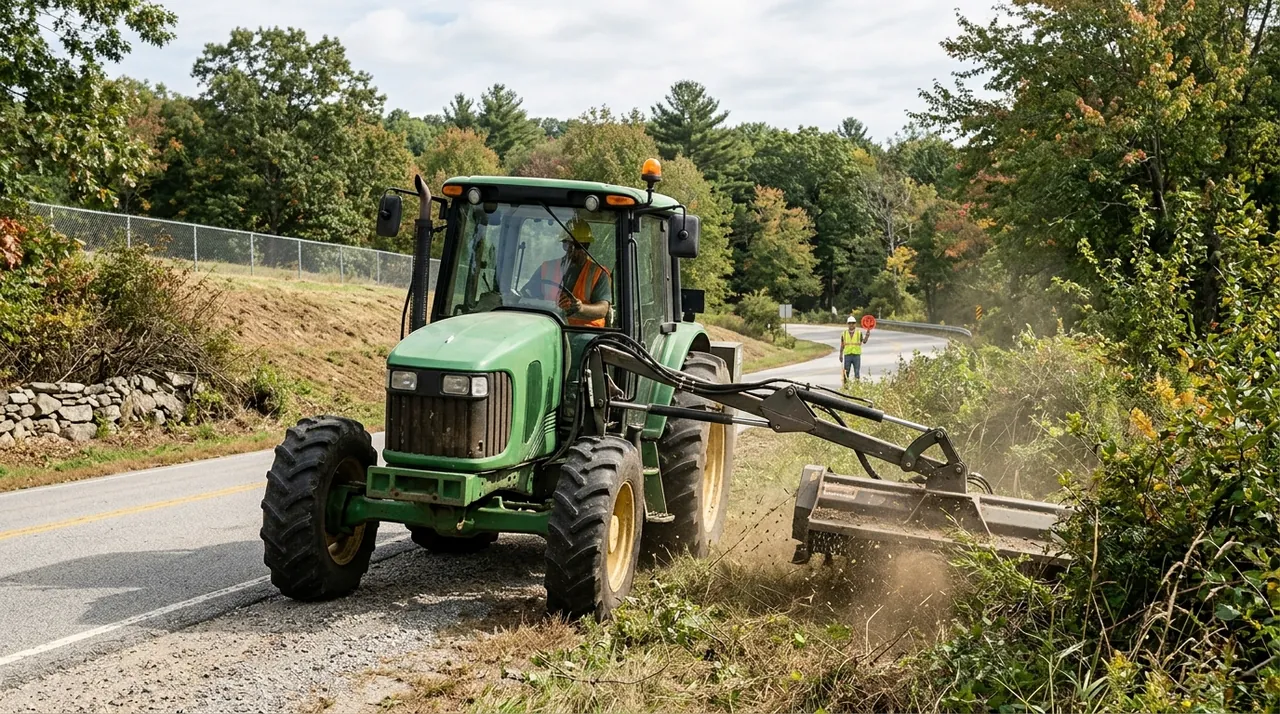
The cutting head on a side-boom mower is where the work happens — and where most of the serious hazards live. Two fundamentally different designs dominate roadside mowing: the flail head and the rotary head. Each has its own mechanics, its own strengths, and its own failure modes. When you are working along a highway shoulder with traffic and pedestrians nearby, choosing the right head and keeping it in sound condition is what separates routine work from a thrown-rock incident.
Flail and Rotary Heads: How They Work and When to Use Each
A flail head uses a rotating horizontal drum studded with many small blades — called hammers or knives — that hang on free-swinging shackles or pins. Because each blade can deflect backward on contact with a solid object, flail heads handle mixed brush, saplings, and debris-littered ground better than a rigid blade would.
A rotary head works more like a scaled-up lawn mower. One or more large rigid blades spin horizontally beneath a protective deck, covering more ground per pass and cutting open grass quickly. The trade-off is that a rigid blade cannot deflect — when it strikes a rock, it either cuts through it or throws it.
Choosing between them comes down to the job: thick brush and mixed material call for a flail; broad grass slopes where finish quality matters lean toward rotary.
Components You Must Know on Each Head Type
On a flail head, the critical components are the drum, the individual hammers or knives, the shackles and pins that hold them, the bearings at each end of the drum, and the belts or driveline that transfer power to the head. A seized bearing or broken belt does not just stop the head — it can create an out-of-balance condition before the rotation stops.
On a rotary head, the deck is the outer housing that contains the blade arc. Below it, the spindle drives the blade, blade bolts lock the blade to the spindle, and anti-scalp rollers protect the head on uneven ground. Blade bolts carry the full rotational load of a heavy spinning blade and must be torqued to specification — a loose blade bolt gives little warning before the blade separates.
The Thrown-Object Hazard and How Guarding Controls It
A spinning mowing head can accelerate a rock or chunk of debris to dangerous speed instantly. Deflectors, chain curtains, and rubber skirting are designed to redirect material downward and limit how far debris travels. None of these eliminate the hazard — they reduce its range. That distinction matters: a machine with all guarding intact still requires a clear zone around it, and bystanders must always be kept outside the discharge arc while the head is turning.
Flail heads generally throw less than rotary heads because the free-swinging hammers release energy on contact rather than ejecting material in a clean arc. That is the main reason flail heads are preferred for roadside work near pedestrians. But neither type is debris-free under normal operating conditions.
Inspection Points and Removal-From-Service Conditions
Before the head goes into service, check every blade or hammer for cracks and wear; verify that all shackle pins are present and undamaged; check blade bolts on a rotary for torque and damage at the mounting holes; inspect bearings for roughness or play; and confirm that all guarding — deflectors, chain curtains, skirting — is present and secured.
Some findings are not judgment calls. A cracked or missing blade on a rotary head causes severe imbalance that accelerates failure across the whole assembly and is an immediate removal-from-service condition. A damaged or missing guard goes the same way. Failed bearings mean the head stays off until repaired. These are the conditions the exam tests, and in the field they must be enforced regardless of schedule pressure.
Key Takeaways
- •Flail heads use many free-swinging hammers on a drum for brush and mixed material; rotary heads use rigid blades under a deck and are faster on open grass but throw debris more aggressively.
- •Know the key components: drum, hammers, shackles, bearings, and belts on a flail; deck, spindle, blades, blade bolts, and anti-scalp rollers on a rotary.
- •The thrown-object hazard exists with both head types — guarding reduces debris range but does not eliminate it, so bystanders must always be kept out of the discharge arc.
- •Flail heads generally throw less than rotary heads because free-swinging hammers release energy on contact, making them the preferred choice near pedestrians and traffic.
- •Remove the head from service immediately for cracked or missing blades or hammers, damaged or missing guarding, or failed bearings — these are automatic, no-exception conditions.