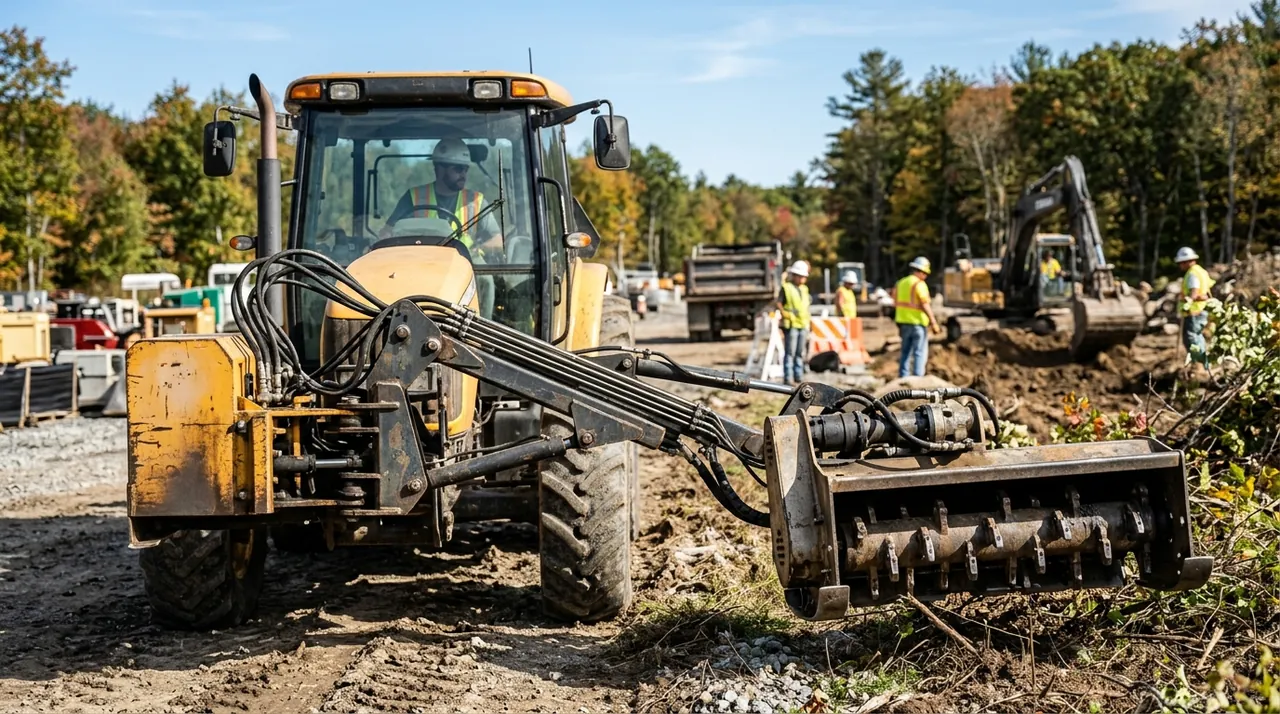
The moment a side-boom mower rolls onto a public road shoulder, the job site becomes a temporary work zone — and everything that goes with that label applies: traffic-control devices, high-visibility gear, a disciplined communication system, and a clear plan for what to do when things go wrong. Roadside mowing looks routine from the cab, but your machine is moving slowly down a live highway while traffic passes within arm's reach. This lesson explains how to set up and maintain the protection your crew needs, what the MUTCD requires, and how to keep the boom, the head discharge, and every person on the ground out of harm's way.
Roadside Mowing as a Moving Work Zone
A mowing operation on a public way is treated the same as any other temporary work zone under traffic-control law. That classification triggers a set of obligations — advance warning, conspicuity devices, and where required, flagging — that do not apply when you are working off the public way entirely. Because the operation moves continuously, the work zone travels with the machine. Advance-warning signs and shadow vehicles must stay in the correct position relative to the mower at all times. Every crew member, including the operator, shares responsibility for maintaining that zone as conditions change throughout the shift. Coordination with the road owner or municipality on lane closures and timing is part of the setup, not an afterthought.
MUTCD: The Basis for Your Traffic-Control Setup
The Manual on Uniform Traffic Control Devices — the MUTCD — is the national standard that defines which signs, signals, and devices are used in temporary traffic-control situations. When you see a MOWING AHEAD sign or an arrow board behind a shadow vehicle on a Massachusetts road, those choices come from MUTCD requirements. Deviating from them is not a judgment call.
For a moving mowing operation, advance-warning signs placed well before the work area give drivers time to react before they encounter the mower. A shadow or protection vehicle — typically carrying an arrow board — follows the carrier to absorb any rear-end impact and guide traffic around the operation. Amber warning and strobe lights on the carrier add conspicuity in low-light or glare conditions. None of these elements are optional when traffic is present.
High-Visibility Apparel, Flagging, and Communication
Anyone exposed to traffic in a roadside work zone must wear high-visibility apparel meeting the appropriate ANSI/ISEA class — a properly rated vest or jacket, not just a reflective strip. Drivers approaching a work zone must see workers early enough to react, and standard clothing provides essentially no help at highway speed.
When a flagger is part of the setup, their positioning and signaling follow standard MUTCD procedures. A flagger controls traffic flow — they do not simply wave people through. The flagger and operator must have a reliable communication method before the shift starts: agreed-upon hand signals or radio contact. Ambiguity between the cab and the ground is how people get hurt.
Boom Control, Head Discharge, and Stopping Work
The boom and cutting head must stay out of the travel lane at all times. In practice this requires active attention: shoulder width varies, the machine drifts on uneven ground, and fixed obstacles force the operator to retract and reposition. Head discharge direction is equally critical — the cutting head throws rocks and debris with significant force. That discharge must always be directed away from the travel lane and away from any ground crew. Mowing direction relative to traffic flow and available sight distance affects both debris control and how much time approaching drivers have to slow down.
If the traffic-control setup is knocked down or becomes inadequate during the shift, stop work immediately and restore proper controls before continuing. Production pressure is never a reason to operate without adequate protection in place.
Key Takeaways
- •Roadside mowing on a public way is a moving temporary work zone — MUTCD-based traffic control applies for the entire shift.
- •Advance-warning signs and a shadow or protection vehicle must travel with the mower and stay correctly positioned at all times.
- •All crew exposed to traffic must wear the required ANSI/ISEA class of high-visibility apparel.
- •Head discharge must always be directed away from the travel lane to prevent debris strikes on passing vehicles.
- •If traffic control is compromised at any point, stop work and restore adequate protection before resuming.