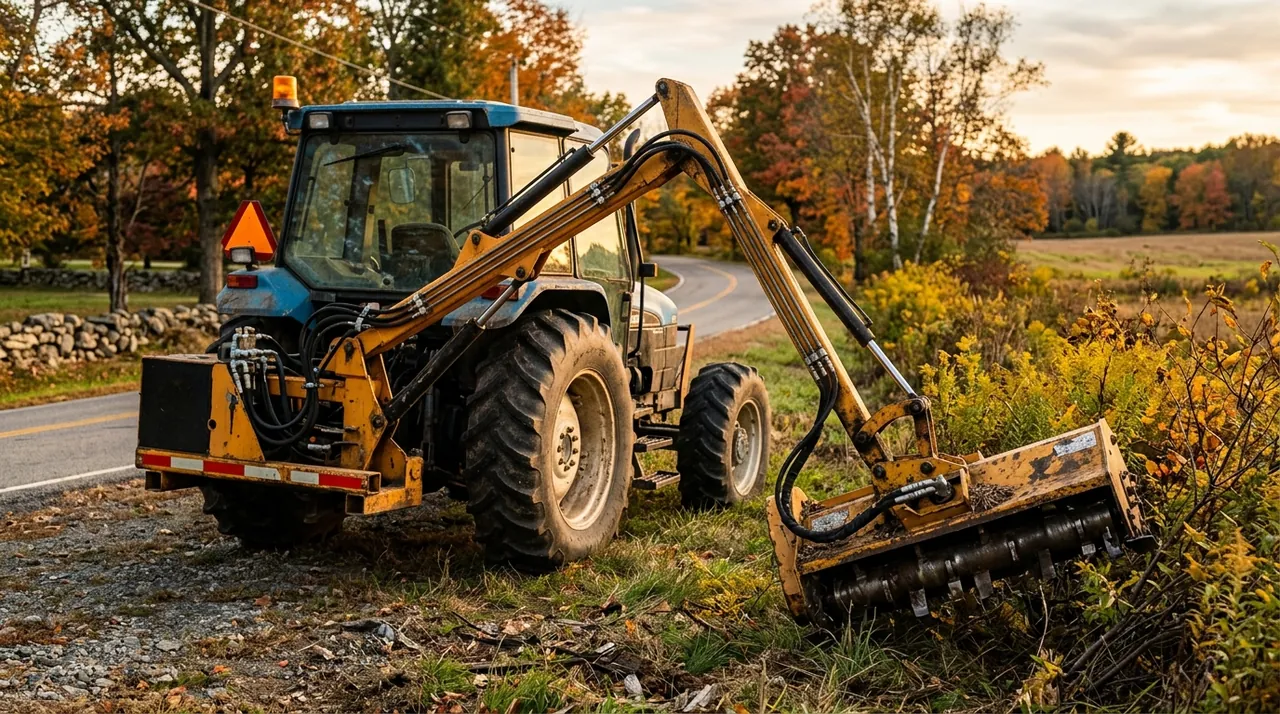
Roadside mowing looks straightforward from the cab, but the combination of sloped terrain, overhead power lines, buried utilities, and debris-filled right-of-way makes it one of the higher-risk operations a 4G side-boom operator faces. This session works through four core hazard categories — slope stability, overhead lines, underground utilities, and thrown objects — and shows what each one demands from the operator.
Slope Stability and the Physics of Sidehill Work
A side-boom mower is designed to reach out over an embankment while the carrier stays on more stable ground, but that geometry creates a real tipping risk. When you extend the boom downhill on a slope, the machine's center of gravity shifts in the same direction. The farther out the head goes, the more leverage the combined weight of boom, gearbox, and cutting head exerts on the uphill wheels. If the carrier is also sitting across the slope rather than aligned up or down it, you have compounded the instability — lateral weight bias plus boom extension can push a machine past its rated tip-over threshold.
The correct positioning rule: keep the carrier on the high side of the slope whenever possible. Operating up-and-down a grade is generally more stable than traversing it. Check the rated slope limits in your machine's operator manual and treat that number as a hard limit. Soft shoulders, ditches, and washouts are the most common way a wheel drops unexpectedly. A shoulder that looks solid from the cab may be undercut by erosion just below the grass — walk the section if there is any doubt.
Overhead and Underground Utility Hazards
Power lines in the right-of-way present a strike hazard any time the boom is moving. The standard minimum clearance principle for overhead energized lines is ten feet — that clearance must be maintained between any part of the boom or head and the nearest conductor. Ten feet sounds generous until the boom is already extended on a slope and your attention is on the ground below. Identify all line locations before you start a pass and build your working arc around them.
Underground hazards are different in character but just as consequential. Utility pedestals, gas valves, water valve boxes, and buried-line markers sit close to the ground surface throughout roadside areas. A low-mounted cutting head running at full speed can strike a pedestal or valve riser, damaging the utility and potentially throwing debris back at the operator. Read the marker flags, maintain appropriate head height, and slow down near any ground-mounted fixture.
Thrown Objects and Pre-Mow Preparation
The cutting head operates at high rotational speed, and the right-of-way accumulates exactly the material that creates projectiles: rocks, bottles, wire, guardrail hardware, and sign posts that have been knocked down and grown over. A direct hit on a large piece of metal can send fragments far enough to penetrate glass or injure a bystander.
The most effective control is the pre-mow walk. Before starting a new section, walk the area at a pace slow enough to spot foreign objects and fixed obstacles — culverts, headwalls, sign posts, and guardrail ends. Remove what you can; note what you cannot. Once mowing begins, keep the head's discharge arc clear of bystanders, parked vehicles, and structures. If a person approaches the work area, stop the head before they get within range. Apply the same rule before any travel move or machine turn: disengage the head, let it come to a full stop, then move the carrier. A spinning head during travel is a hazard to everything in its path.
Ground Conditions and Fixed Obstacles
Wet grass dramatically reduces traction on slopes, and the same grade you ran cleanly in dry conditions can cause the carrier to slide toward the road edge when the surface is wet. Hidden drop-offs near the shoulder — where firm ground transitions abruptly to a ditch — can drop a wheel without warning. When conditions are uncertain, slow down and position the carrier as far from the edge as the work allows.
Guardrails, culverts, headwalls, and fixed signs are not just thrown-object sources — they are direct boom and head strike hazards. Contact between the head and a concrete headwall or steel guardrail post is a high-energy event that damages the machine and surrounding infrastructure. Identify these obstacles during the pre-mow walk and maintain clearance throughout every pass.
Key Takeaways
- •Position the carrier on the high side of the slope; boom extension downhill shifts the center of gravity toward tip-over, so stay within the machine's rated slope limits.
- •Maintain a minimum ten-foot clearance between any part of the boom or head and overhead energized power lines.
- •Walk the right-of-way before mowing to locate foreign objects and identify fixed obstacles such as headwalls, guardrails, and utility pedestals.
- •Keep bystanders, parked vehicles, and structures out of the head's discharge arc — stop the head if anyone approaches.
- •Disengage and fully stop the cutting head before traveling, turning, or repositioning the carrier.