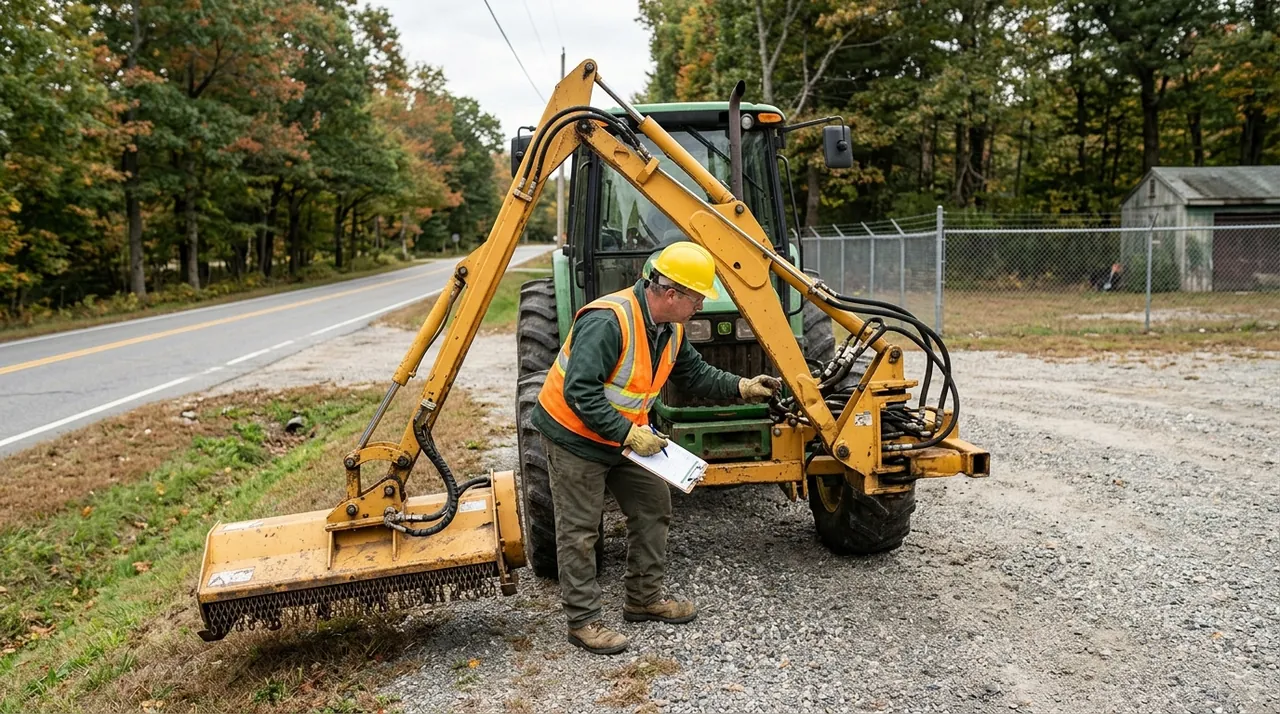
A side-boom mower runs a high-speed cutting head at the end of a hydraulic boom, often within feet of traffic. That combination demands a disciplined pre-shift inspection every day. The walk-around is not a paperwork exercise — it is the moment you decide whether the machine is fit for service. Miss a cracked boom pivot in the yard and you find it on the shoulder with the head on the ground. This session covers what to inspect, when to inspect it, which conditions require immediate removal from service, and how to document what you find.
The regulatory basis and who is responsible
OSHA's construction safety standards — 29 CFR 1926.20 and 1926.602 — require that equipment be inspected by a competent person before use. A competent person is not just someone familiar with the machine; it is someone who can identify a hazard and has the authority to act on it, including pulling the machine from service. On most mowing crews that person is the operator.
The inspection must happen before the first shift of each workday and again after the machine is relocated or transported. Relocation matters because loading and unloading stress structure and hoses, and the new site may present ground conditions the prior location did not. If you drove to a new highway section and climbed aboard without re-checking, you would not know about the hydraulic fitting that started seeping during transport.
The 360-degree walk-around: carrier, boom, and head
Start at a fixed point and work around the machine in one direction so nothing gets skipped. Begin by looking at the ground beneath for fresh fluid — a wet spot is the fastest signal that a leak developed overnight or during transport.
On the carrier, check tire condition or track integrity, confirm lights and mirrors work, verify the ROPS and FOPS are undamaged and unmodified, and test that the seatbelt latches and releases cleanly. Then check fluids: engine oil, hydraulic fluid level and color (milky fluid means water contamination; burnt fluid means heat stress), coolant, and fuel.
Move to the boom and pivot assembly. Inspect welds and base metal for cracks, especially at pivot brackets and cylinder mounts. Check every pin and bushing for excessive play. Trace all hydraulic hoses from carrier to head, looking for chafing, bulges, cracked covers, and seeping at fittings or cylinder rod seals.
At the head, confirm every blade or hammer is secure with no visible cracks, check bearings and belts, and verify all guards and deflectors are in place. Confirm the PTO shaft and driveline are fully guarded — an exposed PTO is a removal-from-service condition and a serious injury risk.
Operator station and functional checks
Once the walk-around is complete, get in the seat and run functional checks before leaving the yard. Cycle every control and confirm it moves freely and returns to neutral: boom extend and retract, boom swing, head on/off, and float. Confirm the horn sounds and warning lights illuminate at startup.
Functional checks catch what the visual inspection cannot. A fitting may look fine and fail under load. A warning light may have a burned-out bulb. A stiff control may signal a failing spool valve. Running every function at low load before you are on a live roadway shoulder is how you find those problems safely.
Removal-from-service conditions and how to handle them
Some findings are judgment calls; others are non-negotiable stops. The following conditions require immediate removal from service: an active hydraulic leak; a damaged, cracked, or modified ROPS or FOPS; a non-functional seatbelt; structural cracks in the boom, pivot, or carrier frame; missing or cracked blades; damaged or missing head guarding; an unguarded PTO; and inoperative warning lights.
When you find one, the procedure is the same every time: take the machine out of service, attach a tag so no one else starts it, and notify your supervisor immediately. Document what you found, where, and when — that record protects you and gives maintenance the information they need. Production pressure does not change this sequence. The exam will present scenarios designed to test exactly that instinct, and so will the job.
Key Takeaways
- •OSHA requires inspection by a competent person under 29 CFR 1926.20 and 1926.602 before each shift and after every relocation or transport.
- •Work a fixed 360-degree route: ground and fluids first, then carrier, then boom and pivots, then head and guarding — in that order every time.
- •Check hydraulic hoses and cylinders closely for chafing, bulges, cracked covers, and seeping fittings; trace the full run from carrier to head.
- •Removal-from-service conditions — active leaks, damaged ROPS/FOPS, failed seatbelt, cracked boom, missing blades, unguarded PTO — mean tag out and notify the supervisor immediately.
- •Follow every visual inspection with functional checks in the seat: controls, float, head on/off, horn, and warning lights before leaving the yard.