Free MA Hoist

OSHA Subpart P — Excavation Safety

2 hours

2A — OSHA Subpart P — Excavation Safety (Excavating Machinery).
2Aexcavating machinery.

Trenches kill quickly. A cubic yard of soil weighs close to a ton, and a wall failure gives a worker almost no time to react. OSHA Subpart P — codified at 29 CFR 1926.650 through 652 — addresses that hazard with a structured set of rules: when protection is required, who evaluates it, how to classify the soil, and which system to use. For the 2A exam, this is high-priority material that shows up directly in scenario-based questions.

The five-foot rule and the competent person

OSHA draws a hard line at five feet: any excavation at or above that depth requires a protective system, period. Below five feet there is a narrow exception — a competent person may determine that conditions present no cave-in hazard — but that call rests entirely on the competent person's shoulders, so it is rarely invoked in practice.

The competent person is a defined term, not just a job title. To qualify, someone must be able to identify existing and predictable hazards, understand soils analysis, and — critically — have the authority to stop work when a hazard is found. Authority without expertise is useless, and expertise without authority means problems get spotted but not acted on. Inspection is required before work begins each day and again after any event that could destabilize the excavation: heavy rain, a freeze-thaw cycle, or significant vibration from traffic or nearby equipment. A clean morning inspection does not cover conditions that develop later in the shift.

Classifying the soil

The right protective system depends on how stable the soil is, so classification comes first. Subpart P uses three types. Type A is the most stable, with an unconfined compressive strength of 1.5 tons per square foot or greater — hard clay, silty clay, caliche, and hardpan. But Type A classification is disqualified if the soil is fissured, has been previously disturbed, is subject to vibration, or contains seams that slope toward the cut. Any one of those conditions drops it to a lower category.

Type B sits in the middle at 0.5 to 1.5 tons per square foot; angular gravel, silt, and previously disturbed Type A all fall here. Type C is the least stable: below 0.5 tons per square foot. Granular soils, submerged soils, and layered systems where the seams dip into the excavation are all Type C. Water accumulation forces a Type C classification regardless of strength test results.

Field tests that competent persons use include thumb penetration (pressing firmly into a fresh sample to estimate resistance), dry strength testing, checking plasticity of a moist sample, and visual inspection for fissuring. Together they support a defensible classification without laboratory equipment.

Choosing and using a protective system

Subpart P offers four protective-system pathways: sloping, manufacturer tabulated data, OSHA appendix tables, or a professional engineer design. Sloping is the most common in open terrain. The required slope ratio depends on soil type — Type A allows a three-quarter horizontal to one vertical cut (53 degrees), Type B requires 1:1 (45 degrees), and Type C requires 1.5:1 (34 degrees). A steeper slope means a narrower cut; accurate soil classification saves excavation width and time.

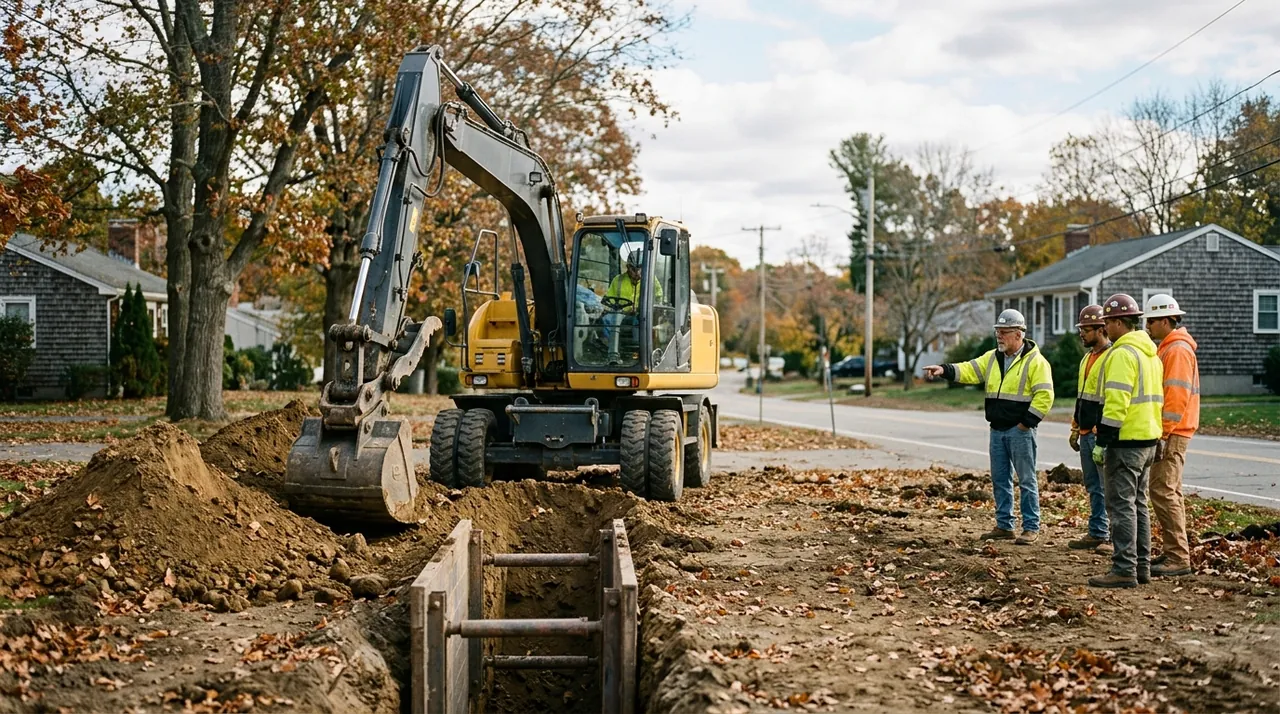
When site geometry makes sloping impractical, a trench box is the typical alternative. The box is a portable steel or aluminum shield set in the trench to resist soil pressure. When removing it, always work bottom-up with simultaneous backfill — pulling the box out from the top without filling first can collapse the exposed walls onto workers.

Two rules apply regardless of system: the spoil pile must be at least two feet back from the trench edge (piled soil adds lateral pressure and becomes a burial hazard if it slides in), and any trench four feet deep or greater must have a ladder, ramp, or stairway within 25 lateral feet of every worker.

Key Takeaways

  • Excavations five feet deep or greater always require a protective system; below five feet a competent person must affirmatively find no hazard.
  • The competent person must identify hazards, understand soils analysis, and have authority to stop work — all three are required.
  • Inspect before each shift and again after rain, freeze-thaw, or vibration; a morning inspection does not cover afternoon conditions.
  • Soil type determines required slope: Type A = three-quarter to one, Type B = 1:1, Type C = 1.5:1; water in the excavation forces Type C.
  • Spoil pile minimum setback is two feet; trench boxes come out bottom-up with simultaneous backfill; ladders are required at four feet depth.

Learning Objectives

  • State the excavation depth threshold that requires a protective system
  • Define "competent person" and list their inspection responsibilities
  • Classify soil into Type A, B, or C using visual and manual tests
  • Select the appropriate protective system for a given scenario

Topics Covered

  • 29 CFR 1926.650–652: OSHA Subpart P — Excavations
  • The 5-foot rule: excavations ≥5 ft deep ALWAYS require a protective system
  • Exception under 5 ft: no system required ONLY IF competent person finds no cave-in hazard
  • Competent person: can identify hazards, knows soils analysis, has authority to stop work
  • Competent person inspection: required before work begins and "as needed" throughout shift
  • Post-event inspection: required after rain, freeze-thaw, or any event that may increase hazard
  • Access and egress: trenches ≥4 ft require a stairway, ladder, or ramp within 25 lateral feet
  • Soil Classification — Type A (most stable):
  • — Unconfined compressive strength ≥1.5 tsf (144 kPa)
  • — Examples: hard clay, silty clay, caliche, hardpan
  • — DISQUALIFIERS: fissured, subject to vibration, previously disturbed, sloped layer
  • Soil Classification — Type B:
  • — Strength 0.5–1.5 tsf (48–144 kPa)
  • — Examples: angular gravel, silt, previously disturbed Type A
  • Soil Classification — Type C (least stable, most aggressive protection):
  • — Strength <0.5 tsf (<48 kPa)
  • — Examples: granular soils, submerged soils, layered systems dipping into excavation
  • Testing methods: thumb penetration, dry strength, plasticity, visual for fissures
  • Protective systems — four design options:
  • 1. Sloping: Type A=¾:1 (53°), Type B=1:1 (45°), Type C=1½:1 (34°)
  • 2. Manufacturer tabulated data (written documentation required)
  • 3. OSHA appendix tables
  • 4. Professional engineer design
  • Trench box (shield): portable, must resist cave-in forces; remove bottom-up with simultaneous backfill
  • Spoil pile setback: minimum 2 feet from trench edge
  • Water accumulation: must be controlled; submerged soils default to Type C

Resources

Self-Check Questions

Question 1: At exactly what excavation depth does OSHA Subpart P require a protective system with NO exceptions?

  1. A. 3 feet
  2. B. 4 feet
  3. C. 5 feet(correct)
  4. D. 6 feet
Show Explanation

Explanation:

At 5 feet or deeper, a protective system is ALWAYS required — period. Between 0 and 5 feet, no system is required only if the competent person determines no cave-in hazard exists. The 5-foot threshold is one of the most commonly tested numbers on the MA hoisting exam.

Question 2: Soil testing shows an unconfined compressive strength of 0.8 tsf, the soil has been previously disturbed, and there is standing water at the bottom. How should this soil be classified?

  1. A. Type A
  2. B. Type B
  3. C. Type C(correct)
  4. D. Stable Rock
Show Explanation

Explanation:

Water accumulation automatically downgrades soil to Type C, regardless of strength. Even though 0.8 tsf would normally indicate Type B, the presence of water in the trench bottom requires the most conservative classification.

Question 3: What is the minimum required spoil pile setback from the edge of an open trench?

  1. A. 1 foot
  2. B. 2 feet(correct)
  3. C. 3 feet
  4. D. 4 feet
Show Explanation

Explanation:

OSHA 1926.651 requires spoil, equipment, and materials to be kept at least 2 feet from the edge of any excavation. Spoil closer than 2 feet adds surcharge load that can trigger a cave-in.

Question 4: A competent person inspects a trench before work begins and finds no hazards. Rain begins during the shift. What must happen?

  1. A. Continue work; the initial inspection covers the full shift
  2. B. Inspect again only if the rain lasts more than 30 minutes
  3. C. Remove workers from the trench and re-inspect before resuming(correct)
  4. D. Reduce the trench depth by one foot and continue
Show Explanation

Explanation:

OSHA requires the competent person to inspect "as needed throughout the shift" and specifically after any rain, freeze-thaw cycle, or other event that may increase hazard. Workers must exit the trench during re-inspection.

Question 5: A trench is 4 feet deep. Workers need to enter it. Is a ladder or egress point required?

  1. A. No — ladders are only required at 5 feet or deeper
  2. B. No — the 4-foot depth does not trigger egress requirements
  3. C. Yes — egress is required for any trench 4 feet deep or deeper(correct)
  4. D. Yes — but only if the worker will be in the trench for more than 30 minutes
Show Explanation

Explanation:

OSHA 1926.651 requires a means of egress (ladder, stairway, or ramp) for any trench 4 feet or deeper. This is a separate threshold from the protective system requirement (5 feet). Workers must be within 25 feet lateral travel of the egress point.

Question 6: Unconfined compressive strength testing shows 1.2 tsf. The soil is fissured. How must it be classified?

  1. A. Type A — 1.2 tsf exceeds the 1.0 tsf threshold for Type A
  2. B. Type B — 1.2 tsf falls in the Type B range and fissuring requires downgrade from Type A(correct)
  3. C. Type C — fissuring is an automatic downgrade to Type C
  4. D. Stable Rock — strength above 1.0 tsf qualifies as stable
Show Explanation

Explanation:

Although 1.2 tsf is between 0.5 and 1.5 tsf (the Type B range), the key issue is that fissured soil cannot be classified as Type A even if it exceeds 1.5 tsf. Fissuring is an explicit disqualifier for Type A. The 1.2 tsf strength puts it squarely in Type B territory.

Question 7: What is the minimum required horizontal-to-vertical slope ratio for a Type B soil excavation?

  1. A. ¾:1 (53°)
  2. B. 1:1 (45°)(correct)
  3. C. 1½:1 (34°)
  4. D. 2:1 (27°)
Show Explanation

Explanation:

Type B soil requires a minimum 1:1 slope — 1 foot horizontal for every 1 foot of vertical depth. Type A allows ¾:1 and Type C requires 1½:1. Memorize these three ratios: they are tested on the 2A exam.

Question 8: Who qualifies as a "competent person" for excavation purposes under OSHA Subpart P?

  1. A. Any licensed hoisting engineer
  2. B. A person capable of identifying cave-in hazards, trained in soils analysis, and with authority to correct hazards(correct)
  3. C. A professional engineer registered in Massachusetts
  4. D. The most senior worker on the job site
Show Explanation

Explanation:

OSHA defines a competent person as someone who can identify existing and predictable hazards, is knowledgeable in applicable soil analysis, protective systems, and regulations, and has the authority to take prompt corrective action. A PE is needed only for engineer-designed protective systems.

Question 9: You are digging a trench in Type C soil and reach a depth of 6 feet. Which protective system is NOT an option under OSHA Subpart P?

  1. A. Sloping at 1½:1 ratio
  2. B. Installing a manufacturer-approved trench box
  3. C. Shoring with tabulated data
  4. D. Relying on the fact that no workers will enter the trench(correct)
Show Explanation

Explanation:

The protective system requirement at 5 feet or deeper applies to the excavation itself — not just when workers are in the trench. An operator positioned at the edge of an unprotected 6-foot trench while working is also protected by Subpart P requirements.

Question 10: What is the correct procedure when removing a trench box from a completed trench?

  1. A. Remove the box completely, then backfill from the bottom
  2. B. Remove the box from the bottom upward while simultaneously backfilling to maintain protection(correct)
  3. C. Backfill completely to the top, then pull the box straight out
  4. D. Leave the box in place and bury it with the backfill to save time
Show Explanation

Explanation:

OSHA requires trench boxes to be removed from the bottom upward, with backfill placed simultaneously to maintain cave-in protection for any workers still finishing up at the trench. Removing the box entirely before backfilling exposes workers to a cave-in.

In-depth reference for this session →

A deeper, regulation-by-regulation companion page for this lesson.