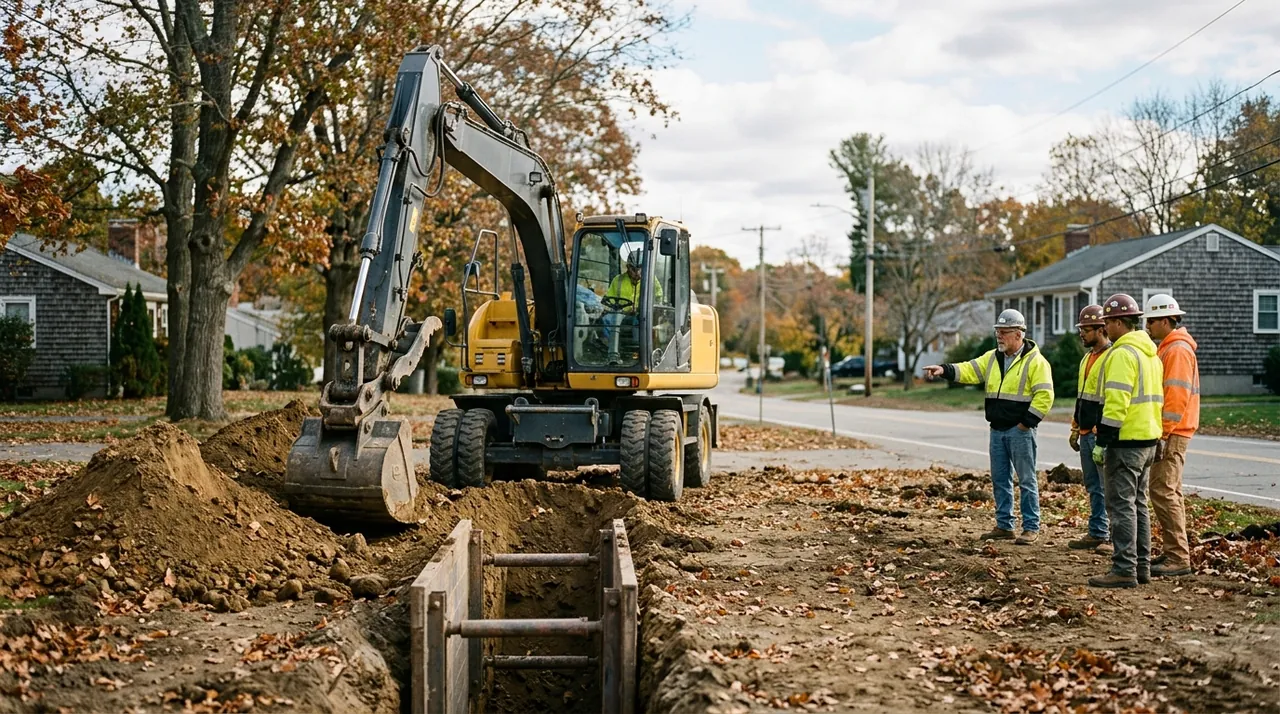
Trenches kill quickly. A cubic yard of soil weighs close to a ton, and a wall failure gives a worker almost no time to react. OSHA Subpart P — codified at 29 CFR 1926.650 through 652 — addresses that hazard with a structured set of rules: when protection is required, who evaluates it, how to classify the soil, and which system to use. For the 2A exam, this is high-priority material that shows up directly in scenario-based questions.
The five-foot rule and the competent person
OSHA draws a hard line at five feet: any excavation at or above that depth requires a protective system, period. Below five feet there is a narrow exception — a competent person may determine that conditions present no cave-in hazard — but that call rests entirely on the competent person's shoulders, so it is rarely invoked in practice.
The competent person is a defined term, not just a job title. To qualify, someone must be able to identify existing and predictable hazards, understand soils analysis, and — critically — have the authority to stop work when a hazard is found. Authority without expertise is useless, and expertise without authority means problems get spotted but not acted on. Inspection is required before work begins each day and again after any event that could destabilize the excavation: heavy rain, a freeze-thaw cycle, or significant vibration from traffic or nearby equipment. A clean morning inspection does not cover conditions that develop later in the shift.
Classifying the soil
The right protective system depends on how stable the soil is, so classification comes first. Subpart P uses three types. Type A is the most stable, with an unconfined compressive strength of 1.5 tons per square foot or greater — hard clay, silty clay, caliche, and hardpan. But Type A classification is disqualified if the soil is fissured, has been previously disturbed, is subject to vibration, or contains seams that slope toward the cut. Any one of those conditions drops it to a lower category.
Type B sits in the middle at 0.5 to 1.5 tons per square foot; angular gravel, silt, and previously disturbed Type A all fall here. Type C is the least stable: below 0.5 tons per square foot. Granular soils, submerged soils, and layered systems where the seams dip into the excavation are all Type C. Water accumulation forces a Type C classification regardless of strength test results.
Field tests that competent persons use include thumb penetration (pressing firmly into a fresh sample to estimate resistance), dry strength testing, checking plasticity of a moist sample, and visual inspection for fissuring. Together they support a defensible classification without laboratory equipment.
Choosing and using a protective system
Subpart P offers four protective-system pathways: sloping, manufacturer tabulated data, OSHA appendix tables, or a professional engineer design. Sloping is the most common in open terrain. The required slope ratio depends on soil type — Type A allows a three-quarter horizontal to one vertical cut (53 degrees), Type B requires 1:1 (45 degrees), and Type C requires 1.5:1 (34 degrees). A steeper slope means a narrower cut; accurate soil classification saves excavation width and time.
When site geometry makes sloping impractical, a trench box is the typical alternative. The box is a portable steel or aluminum shield set in the trench to resist soil pressure. When removing it, always work bottom-up with simultaneous backfill — pulling the box out from the top without filling first can collapse the exposed walls onto workers.
Two rules apply regardless of system: the spoil pile must be at least two feet back from the trench edge (piled soil adds lateral pressure and becomes a burial hazard if it slides in), and any trench four feet deep or greater must have a ladder, ramp, or stairway within 25 lateral feet of every worker.
Key Takeaways
- •Excavations five feet deep or greater always require a protective system; below five feet a competent person must affirmatively find no hazard.
- •The competent person must identify hazards, understand soils analysis, and have authority to stop work — all three are required.
- •Inspect before each shift and again after rain, freeze-thaw, or vibration; a morning inspection does not cover afternoon conditions.
- •Soil type determines required slope: Type A = three-quarter to one, Type B = 1:1, Type C = 1.5:1; water in the excavation forces Type C.
- •Spoil pile minimum setback is two feet; trench boxes come out bottom-up with simultaneous backfill; ladders are required at four feet depth.